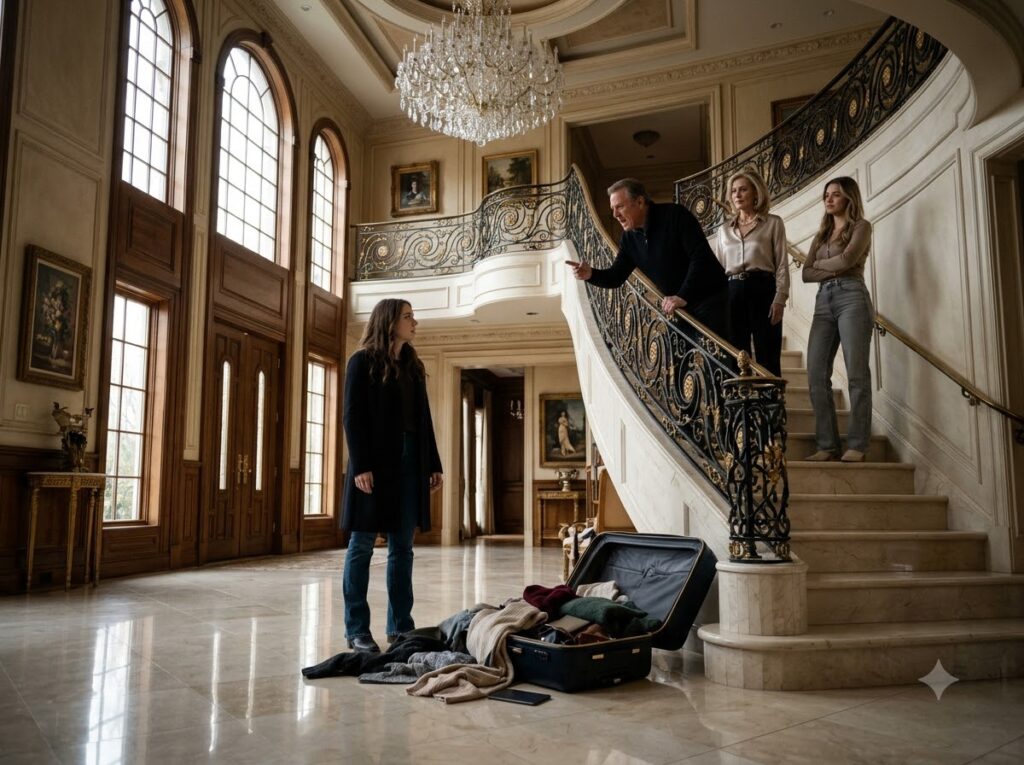
My mother, Beatrice, smoothed the front of her designer cashmere cardigan, her lips curved into that familiar, sickeningly sweet smirk. She had spent my entire life perfecting that look—a silent communication that I was a nuisance, a mistake, a placeholder until my younger sister, Chloe, came along. And there was Chloe, leaning against the mahogany banister, chewing a piece of gum with a bored, insolent rhythm.
“You heard him,” Chloe snapped, holding out her manicured hand, palm up. “The card. You don’t get to live off our name anymore. Leave the Platinum, the Black card, and the keys to the Porsche.”
I stood up, snapping the latches of my suitcase shut. I looked at the three of them—the architects of my misery, the parasites who had spent the last decade gorging themselves on a fortune they neither earned nor understood.
My grandfather had left his entire estate and his software company to me, bypassing my father entirely because he knew Arthur was a feckless, greedy incompetent. But I had been nineteen, grieving, and naive. I had given my father power of attorney. I had let him manage the family office. Over the years, they had slowly conditioned me to believe that I was merely a beneficiary of their hard work, that the mansion, the cars, and the endless luxury vacations were the result of my father’s business acumen, not the dividends of the algorithms I had coded and the patents I held.
“The card, Elara,” my father barked, taking a menacing step down the stairs. “Don’t make me call security to strip search you on your way out.”
I reached into my designer handbag—purchased with my own dividends, though they would claim otherwise—and pulled out the heavy, matte-black titanium credit card. It was linked to the primary operational account of the family trust. I held it between my index and middle finger, letting the overhead chandelier catch its metallic edge.
“Take it,” I said, my voice dangerously calm, devoid of the hysterics they had expected. I tossed it lightly. It clattered against the marble, sliding to a stop right at Chloe’s feet.
Chloe scooped it up with the eagerness of a starving animal. She didn’t even look at me; her eyes were already glazed over with the dopamine hit of unbridled consumerism. She was already planning her trip to the boutiques on Fifth Avenue.
“You owe us everything,” my father sneered, crossing his arms over his chest. “We raised you. We housed you. And now you have the audacity to question my investments? To demand an audit of my books? You are financially cut off. You are dead to this family. Get out.”
“Goodbye, Arthur,” I said quietly. I didn’t call him Dad. I hadn’t felt like a daughter in years. I picked up my suitcase, turned my back on the people who shared my blood, and walked out the heavy oak doors into the freezing, torrential rain.
I didn’t take the Porsche. I had ordered a black car ten minutes before the argument reached its climax. It was idling at the end of the circular driveway, the driver holding an umbrella open, waiting for me. I climbed into the back, the heavy door shutting out the sound of the storm, and let out a long, shuddering breath.
I was homeless. I was ostensibly cut off from my family.
And I had never felt so entirely, dangerously powerful.
From the leather seat of the town car, I pulled out my secure laptop and connected to my private hotspot. The screen flared to life, casting a blue glow over my face. I brought up the secure portal for the banking institution that managed the family trust.
Three days ago, I had noticed a discrepancy—a small, seemingly innocuous transfer of fifty thousand dollars to a holding company I didn’t recognize. My father had always been sloppy, but he was arrogant enough to believe I would never look. Once I pulled that single thread, the entire tapestry of their embezzlement unraveled. Over the past six years, Arthur and Beatrice had siphoned nearly forty million dollars from my trust into offshore shell companies in the Caymans and Cyprus. They had forged my signature on board resolutions. They had leveraged the intellectual property of my software company to take out massive, high-interest collateralized loans to fund their absurd lifestyle—the yachts, the art, Beatrice’s endless charity galas where she played the benevolent queen.
But their greed wasn’t their fatal mistake. Their fatal mistake was how they structured the fraud. In an attempt to shield themselves from immediate tax liabilities, my father had routed the stolen funds through a series of corporate entities that were strictly regulated by federal oversight. He had unknowingly committed massive, indisputable federal wire fraud and securities fraud, leaving a digital paper trail so wide and luminous it could be seen from space.
When I discovered this, I didn’t confront them immediately. I didn’t cry. I sat in my home office and meticulously downloaded every ledger, every forged email, every routed IP address. I packaged it into a neatly encrypted dossier. Then, I invoked a little-known clause in the trust’s bylaws that allowed the primary beneficiary to trigger an immediate, unannounced forensic audit by an independent third-party firm if financial malfeasance was suspected.
I had signed the authorization yesterday. The auditing firm, flanked by federal regulators I had tipped off through my attorneys, had silently locked down the backend of the trust’s financial architecture at midnight.
The accounts looked normal on the surface. Balances appeared high. The cards seemed active. But they were trapped in a digital amber. Any transaction over ten thousand dollars would not only be flagged—it would trigger a cascading freeze across all associated domestic and international accounts, pinging the fraud departments and the FBI field office that was currently reviewing my dossier.
I needed them to make one massive, undeniable attempt to spend stolen funds to spring the trap. I needed them to demonstrate malicious intent to the authorities.
Popular Posts
→- 1
- 2
- 3
- 4




Recently Viewed
Stories you read recently will appear here.





