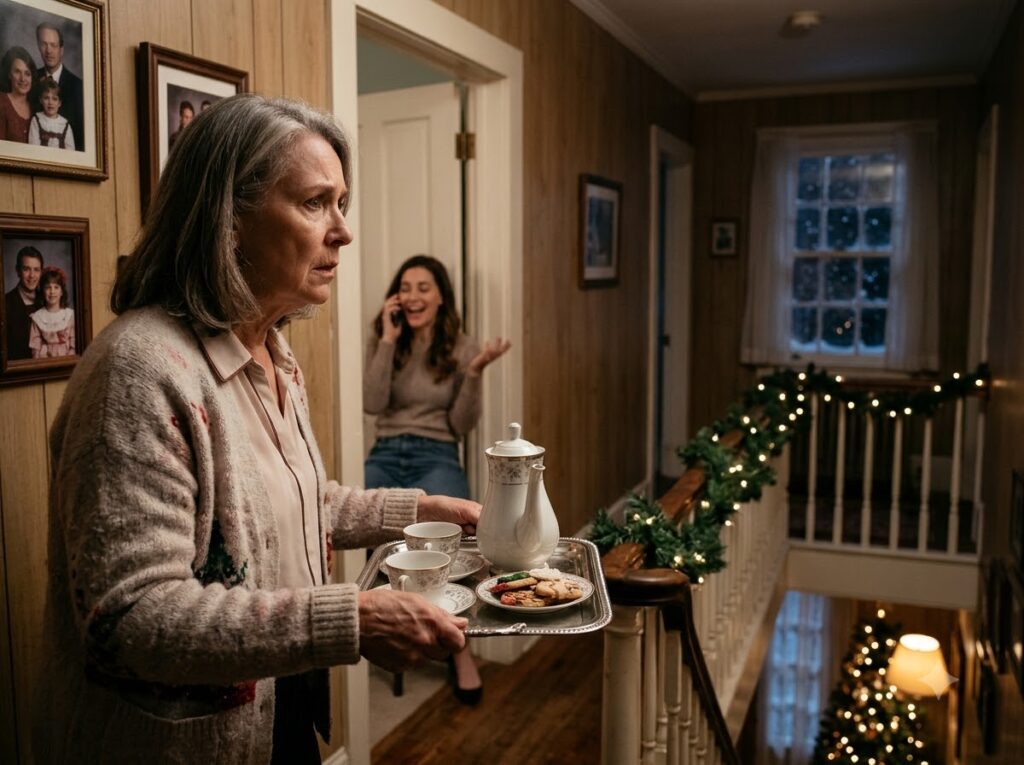
Julian will handle Martha.
The words echoed in my mind, far louder than the muted television downstairs playing a cheerful holiday jingle. My son. My Julian. The boy who used to hide behind my legs when thunderstorms rolled off the Atlantic, the young man who had held my hand and wept openly at his father’s funeral, had promised his wife that he would handle me. Like a nuisance. Like an obstacle to be cleared from their path to prosperity.
Through the crack in the door, Vanessa’s voice continued, a low, triumphant purr. “No, the contractors finished the interior last week. We ripped out all that dreadful, rotting cedar. It’s shiplap now, very crisp, very coastal-modern. And we pitched the old furniture. Honestly, the smell of that ancient upholstery was giving me migraines just thinking about it. We’ll list it on the premium rental tier through the spring, and by June, we’ll move in. She rarely goes up there anyway. We’ll just tell her it’s a surprise renovation to save her the maintenance. You know how Julian is—he’ll spin it perfectly.”
She laughed again, a sound like glass breaking.
I turned away from the door, placing one trembling foot in front of the other, moving with the agonizing slowness of a ghost haunting its own halls. I carried the tray back to the kitchen, setting it down on the granite island with a heavy thud. I braced my hands against the counter, bowing my head as the room spun. Betrayal is a physical thing. It does not just break the heart; it hollows out the stomach, steals the air from the lungs, and replaces the blood in your veins with ice water.
Thomas and I had bought that Maine house twenty-eight years ago. It was a sanctuary, a humble cedar-clad refuge perched on a rugged cliff overlooking the churning gray expanse of the ocean. It was not meant to be a luxury estate. It was meant to be a home. I remembered the exact shade of the faded floral armchair by the window where Thomas used to read his naval history books. I remembered the scent of pine needles, salt spray, and the lavender soap I kept in the clawfoot tub. And I remembered the crooked deck, built by Thomas’s own blistered hands. To Vanessa, it was rotting wood to be ripped away. To me, it was the altar where I had worshipped my husband’s memory until the agony of his passing finally subsided into a gentle, enduring ache.
And my son had helped her tear it down.
“Mom?”
I jolted, turning toward the kitchen doorway. Julian stood there, dressed in a tailored charcoal sweater, looking every inch the successful junior partner at his law firm. His dark hair, inherited from Thomas, was neatly styled. He offered me a warm, easy smile—the same smile that had charmed his way out of missed curfews and broken vases two decades ago.
“Everything okay?” he asked, stepping into the kitchen. “You’ve been gone a while with that coffee.”
I looked at him, truly looked at him, searching for the boy I had raised. I wondered when the entitlement had seeped in, when the ambition had curdled into greed. Had I loved him too much? Had I given him too freely, cushioning every fall until he believed the world—and everything I owned—was rightfully his?
“I’m fine, darling,” I said, and the steadiness of my own voice surprised me. It was smooth, calm, the voice of a matriarch who had hosted a thousand dinner parties and weathered a thousand storms. “I just realized I forgot the sugar bowl. You know how Vanessa loves her sugar.”
“Let me help you,” Julian said, reaching for the tray. His hand brushed mine, and it took every ounce of my willpower not to recoil from his touch.
“No, no, I have it,” I insisted, picking up the tray once more. “Go on back to the living room. I’ll be right there.”
I survived Christmas Eve through a feat of dissociation. I smiled as Vanessa praised the roasted tenderloin. I nodded politely as Julian talked about his latest corporate acquisition. I watched them exchange meaningful, conspiratorial glances over their wine glasses, their secret hanging in the air between them like a shimmering, toxic bubble. They thought I was oblivious. They thought I was a naive, aging widow who would simply nod and sign away my sanctuary when the time came.
That night, lying alone in my bed, the tears finally came. I wept into my pillow, mourning the loss of my Maine house, but more profoundly, mourning the loss of the son I thought I knew. I cried until my chest ached and my eyes burned. And then, around three in the morning, the tears stopped. The sorrow evaporated, leaving behind a cold, hard expanse of clarity.
They had mistaken my grief for weakness, and my generosity for foolishness. But I was Thomas’s wife. I had navigated the world alongside a man who built things to last, who faced down ocean gales without blinking. The deed was in my name. The house was mine.
I was not going to be handled.
The Gathering Evidence
The day after Christmas, Julian and Vanessa packed their luxury SUV and drove back to the city, enveloping me in hugs and hollow promises to visit soon. I stood on the porch and waved until their taillights disappeared around the bend of the snow-lined street.
The moment they were gone, I walked into my study, locked the door, and opened my laptop.
If they had been renting the house out to recover renovation costs, there would be a digital trail. I navigated to the major short-term rental websites and began typing in the town in Maine. It took me less than twenty minutes to find it.
The listing was titled: “The Edge of Eternity: Luxury Cliffside Retreat.”
Popular Posts
→- 1
- 2
- 3
- 4




Recently Viewed
Stories you read recently will appear here.





