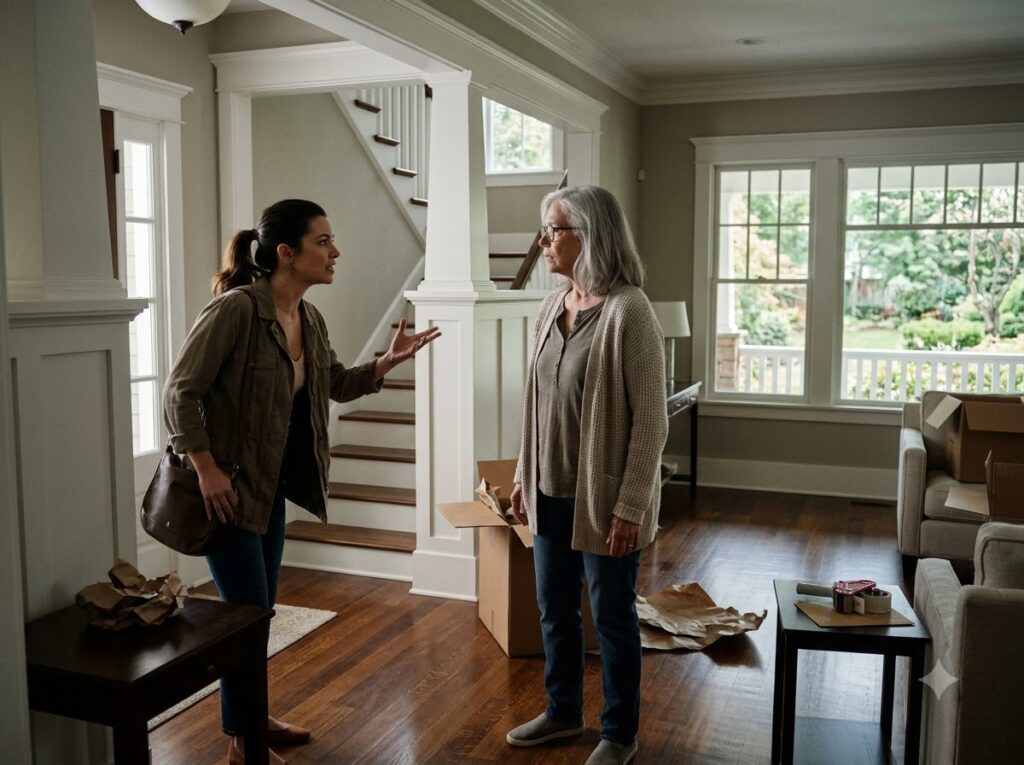
“Excuse me?” I finally managed, my voice dangerously calm.
“You heard me, Elizabeth,” she huffed, pacing across the gleaming hardwood floors of my living room, her heels clicking aggressively. “My parents’ landlord is selling their building. They have nowhere to go. My sister and her three kids are staying with them, so they’re all being evicted. We’ve been panicking for weeks, and David told me you were looking at properties. I assumed—we all assumed—you were buying a family estate so we could combine households. It was the only thing that made sense!”
I felt a cold flash of disbelief wash over me. “You assumed that my money, from my late husband’s life insurance, was going to fund a commune for your extended family?”
“It’s not a commune, it’s family!” Sarah shrieked, gesturing wildly at the empty, sunlit space. “You’re a sixty-eight-year-old widow! What on earth are you going to do with four bedrooms? It’s completely selfish! I already told my mother she could have the master suite because of her bad knees, and my sister could take the two smaller rooms for her and the kids. You could have stayed in your apartment, or taken the downstairs study here!”
The sheer audacity of her entitlement took my breath away. She had not only spent my money and claimed my home in her mind, but she had relegated me to a downstairs study in the house I had saved for five years to buy.
“Sarah,” I said, stepping toward the front door and opening it wide. “Get out.”
She froze, her indignant expression faltering for a fraction of a second before hardening again. “What?”
“You heard me. Get out of my house. And I suggest you call your mother immediately and tell her she needs to start looking for a rental, because absolutely none of you are moving in here.”
“You can’t do this!” she screamed, her face turning an ugly shade of magenta. “We’re family! David won’t stand for this. He’ll make you see reason!”
“David is my son, but he does not own my bank account, and he certainly does not own the deed to this house. Goodbye, Sarah.”
She stormed out, practically vibrating with rage, slamming my beautiful heavy oak door behind her so hard the glass panes rattled.
I locked the deadbolt, walked into my empty kitchen, and leaned against the counter. My hands were shaking, not from fear, but from a deep, volcanic anger. I loved my son, David, but for years I had watched him bend over backward to accommodate Sarah’s demanding, boundary-stomping family. I had kept my mouth shut to keep the peace. I had smiled at Thanksgiving dinners where Sarah’s mother criticized my cooking. I had bought expensive gifts for Sarah’s nieces and nephews while my own birthday passed with a generic text message.
But this? This was the line in the sand.
The phone call came less than an hour later.
“Mom, what did you do?” David’s voice was frantic, tinged with that familiar, exhausted whine he always adopted when Sarah was on the warpath. “Sarah is crying hysterically. She says you kicked her out and told her you’re abandoning her family on the streets.”
“I didn’t put them on the streets, David. Their landlord did,” I replied, pouring myself a glass of iced tea and walking out to my wraparound porch. The afternoon sun was warm, and my garden looked peaceful. I refused to let them ruin my first day here. “Your wife came into my home and demanded to know why I hadn’t consulted her before buying it. She then informed me she had promised three of my bedrooms to her parents, her sister, and her sister’s children.”
There was a long pause on the line. “Mom… I know it’s a lot to ask. But they really are in a tight spot. And you do have all that extra space. It would only be for a few months. A year, tops.”
“David Fischer,” I said, my voice dropping an octave. “Did you know about this plan?”
He hesitated. That hesitation told me everything I needed to know.
“She… she brought it up a few weeks ago when we found out you were looking at bigger houses,” he mumbled. “I told her it wasn’t a good idea, but she said it made perfect financial sense. And Mom, honestly, why did you buy a four-bedroom house for just yourself? It’s kind of excessive. If you let them stay, they could help with chores, and you wouldn’t be so lonely.”
“I am not lonely, David. I enjoy my peace. I bought this house because I want a painting studio, I want a library, and I want a comfortable guest room for my friends. I bought it because I survived your father’s cancer, I survived the grief that followed, and I earned the right to live exactly how I want to. If Sarah’s family needs a house, they can buy one. Or you can invite them into your apartment.”
“We only have two bedrooms!” he protested.
“Then I guess they’ll be sleeping on your couch,” I said firmly. “I love you, David. But my home is not a boarding house. Do not ask me this again.”
I hung up before he could respond. I knew it wouldn’t be the end of it. People like Sarah and her family did not take the word “no” gracefully. They operated on a twisted logic where anyone else’s good fortune was a resource they were inherently entitled to.
For the next two weeks, my phone blew up constantly. There were guilt-tripping text messages from Sarah. There were tearful, manipulative voicemails from Sarah’s mother, Brenda, wailing about how she was too old to be homeless and how she couldn’t believe a “fellow grandmother” could be so cruel. Even Sarah’s sister, Chloe, found me on social media to send me a lengthy, expletive-laden message calling me a selfish boomer hoarding wealth.
Popular Posts
→- 1
- 2
- 3
- 4




Recently Viewed
Stories you read recently will appear here.





