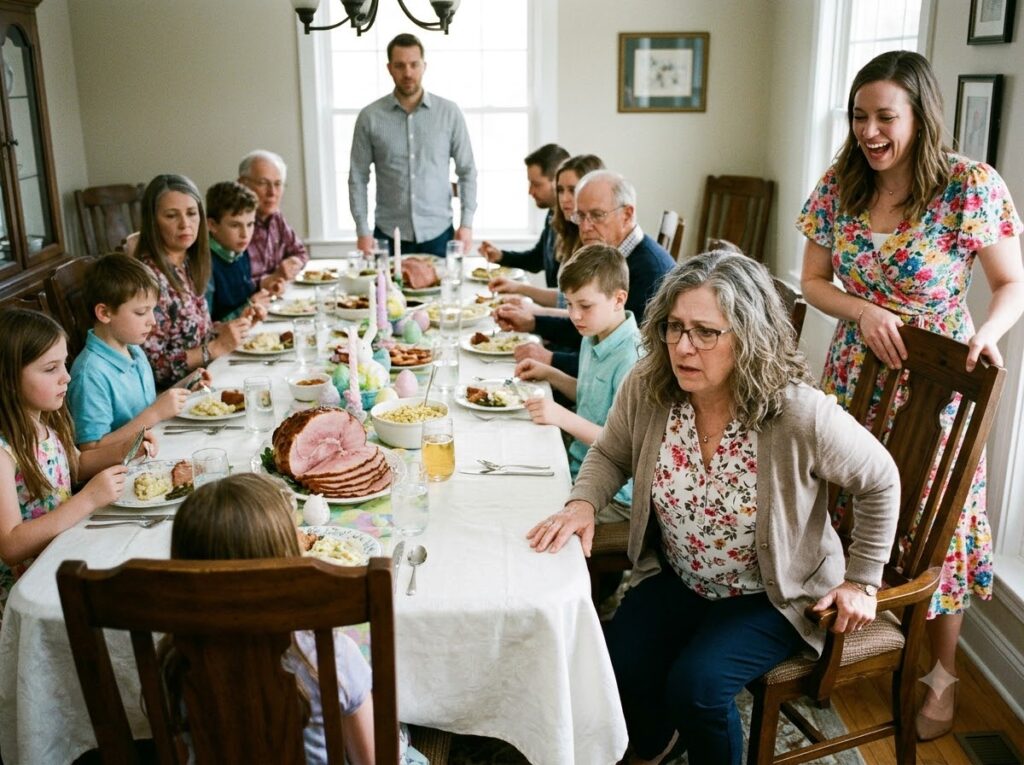
I looked at Derek again. My son. The boy I had rocked through colicky nights, the teenager I had held as he wept at his father’s funeral, the man whose college tuition I had paid by working extra shifts during the summers. He was staring at his glazed ham. He picked up his fork, took a bite, and chewed.
He wasn’t going to say a word.
Something deep and vital snapped inside my chest at that exact moment. It wasn’t a loud, dramatic break, but a quiet, clean severing, like a dead branch finally dropping from an old oak tree.
“Well,” I said softly, my voice miraculously steady. I pulled myself fully upright, smoothing the front of my floral blouse. “I suppose you’re right, Brianna. I don’t belong here.”
“Oh, Pauline, I was just joking,” Brianna drawled, though her eyes were cold and triumphant. “Don’t be so sensitive. Sit down. There’s a folding chair in the kitchen.”
“No, thank you,” I replied. I didn’t raise my voice. I didn’t look at the other guests—Brianna’s parents, her sister, her affluent friends. I just looked at my son. “Derek. Happy Easter.”
I turned on my heel and walked out of the dining room. I didn’t stop in the kitchen to gather the three expensive side dishes I had spent my morning preparing. I walked straight to the front closet, retrieved my coat and my purse, and walked out the front door. The click of the heavy deadbolt closing behind me sounded like a final judgment.
The drive back to my modest, single-story brick house was thirty minutes of profound silence. I didn’t turn on the radio. I just let the reality of the last decade wash over me, stripping away the excuses I had been making for my son and his wife.
When Derek married Brianna five years ago, I knew she had expensive tastes. She came from a family that valued appearances above all else, but didn’t have the actual wealth to sustain it. When they were house-hunting, they were denied a mortgage for the massive, five-bedroom colonial Brianna simply had to have. Derek had come to my house, sat at my kitchen table, and cried. He said he felt like a failure as a husband.
So, I did what a mother does. I reached into my savings—the money my late husband Arthur and I had painstakingly put away for our retirement—and gave them forty thousand dollars for the down payment.
I called it a gift, but the unspoken promise of family is that you are valued, respected, and cared for in return.
That was just the beginning. The “expensive” nature of my love had become a monthly subscription. When Brianna decided she needed a luxury SUV to match the neighborhood, I co-signed the lease and ended up making the eight-hundred-dollar monthly payments when Derek’s commission checks “fell short.” When they wanted to take Brianna’s family to Disney World, I paid for the flights. I paid the property taxes on that massive colonial two years in a row.
I had funded the very table I was just banished from.
When I walked into my quiet, empty house, I didn’t cry. I made a pot of Earl Grey tea, walked into my small home office, and opened my filing cabinet. For a retired librarian, cataloging information is a reflex. I pulled out every bank statement, every loan document, and every receipt from the last five years.
I laid them out on my desk. I highlighted every transfer made to Derek and Brianna’s joint account. I tallied up the car payments, the property taxes, the emergency “loans” for a broken boiler and a flooded basement.
The final number at the bottom of my legal pad was staggering. One hundred and twelve thousand dollars.
I had jeopardized my own financial security to buy the affection of a daughter-in-law who despised me and a son who was too much of a coward to defend me.
Never again.
Monday morning began at exactly 8:30 AM at the First National Bank branch downtown. I sat across from a bewildered branch manager named Thomas and handed him a list of instructions.
First, I severed the automatic monthly transfer of eight hundred dollars to Derek’s account for the car lease. Second, I removed my name as a guarantor from the joint credit card Brianna used for her “incidentals”—a card I had been paying off entirely by myself. Third, I withdrew the ten thousand dollars I had set aside in a separate account for my future grandchild’s college fund, transferring it back into my primary retirement trust. If they were going to treat me like a nuisance, they could finance their own legacy.
By 11:00 AM, I was sitting in the mahogany-paneled office of my estate attorney, Mr. Caldwell.
“Pauline, it’s good to see you, though this is quite sudden,” he said, adjusting his glasses as he looked over my file. “What can I do for you today?”
“I need to rewrite my will, Robert,” I said clearly. “And I need to draft a formal quitclaim deed for my house, placing it into an irrevocable trust.”
He frowned slightly. “Currently, Derek is the sole beneficiary of your estate. Do you want to add Brianna?”
“I want to remove Derek entirely,” I replied, not a single tremor in my voice. “My pension, my savings, and the proceeds from the eventual sale of my home are to be divided equally between the Nashville Public Library Foundation and the American Heart Association in Arthur’s name. Derek is to receive exactly one dollar, just to ensure he cannot contest the will by claiming he was forgotten.”
Mr. Caldwell’s eyebrows rose, but he was a professional. He didn’t ask for the emotional details. He simply nodded and began drafting the paperwork.
The trap was set. Now, it was just a matter of time before the reality of their lifestyle caught up with their actual income.
Popular Posts
→- 1
- 2
- 3
- 4




Recently Viewed
Stories you read recently will appear here.





