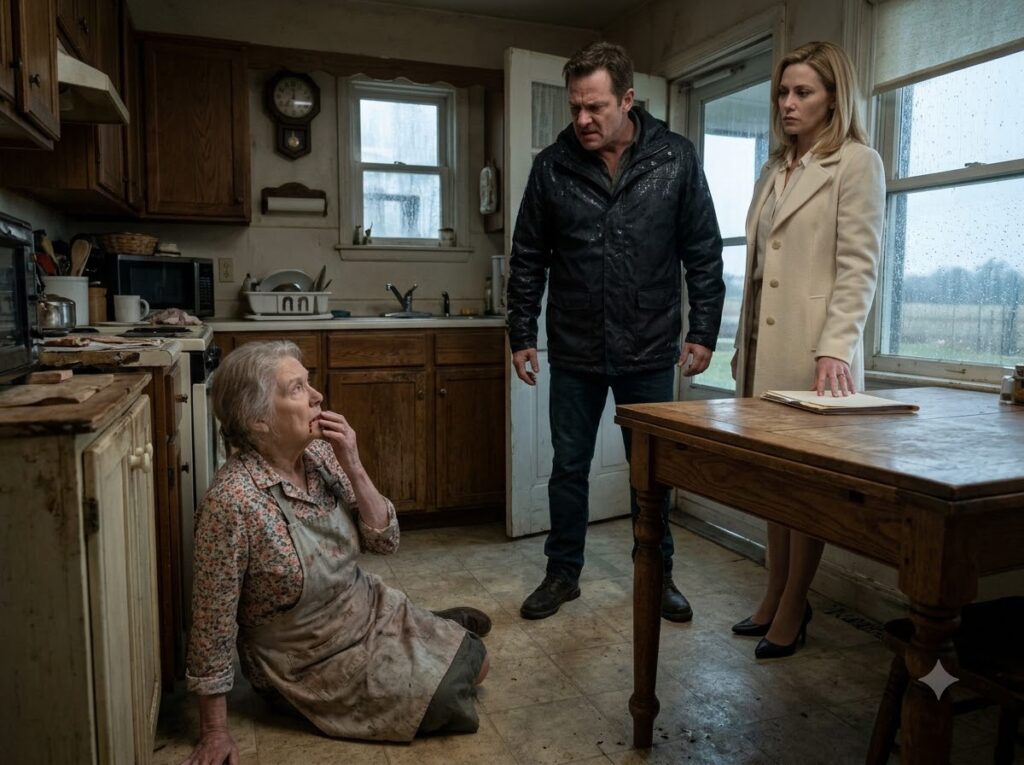
Daniel did not look at the blood. He kept his eyes fixed on the manila folder sitting on the table between us. The boy I had carried for nine months, the boy whose scraped knees I had bandaged on this very porch, was gone. In his place stood a stranger in a tailored suit, his face flushed with a desperate, ugly kind of rage.
“You brought this on yourself, Mom,” he said, though his voice lacked the conviction of his strike. He shifted his weight, his broad shoulders blocking the hallway door, trapping me in the kitchen. “I didn’t want to do that. But you’re not thinking clearly. You haven’t been thinking clearly for months. The doctor said the grief would accelerate the cognitive decline, and he was right. You’re living in a fantasy world if you think you can run a two-hundred-acre apple orchard by yourself.”
“The trees have managed to grow for forty years without your permission, Daniel,” I said, my voice remarkably steady despite the tremor in my hands.
Vanessa sighed, an exaggerated, theatrical sound that cut through the hiss of the woodstove. She unbuttoned her cream coat, shedding raindrops onto the antique rug I had braided by hand the winter Daniel was born. “Daniel, please. Stop arguing with her. We don’t have time for this rustic melodrama. The courier for the development group needs these documents by five o’clock. Just guide her hand to the signature line. If she’s legally incapacitated, you have power of attorney anyway.”
“I do not have dementia,” I said, looking directly into Vanessa’s pale, assessing eyes. “And he does not have power of attorney. Samuel made sure of that.”
Daniel’s jaw tightened. “Dad was a stubborn old fool who didn’t understand how the world works. He died in the mud, holding onto a piece of dirt that’s bleeding us dry. I am trying to save you, Mom. Blackwood Holdings is offering two million dollars. Two million. You can move into the assisted living facility in town. It has a beautiful garden. You won’t have to worry about the roof leaking, or the frost killing the crop, or chopping your own firewood.”
“Blackwood Holdings,” I repeated, tasting the name along with the blood. It was the name printed on the relentless barrage of letters that had been arriving in the mail since the week after Samuel’s funeral. Letters demanding soil tests, letters claiming eminent domain exemptions, letters threatening exorbitant property tax reassessments.
I looked at the folder on the table. The contract lay open, the stark black ink demanding the surrender of my entire life.
That morning, before the storm blew in, I had gone out to the barn to fetch the last of the dry apple wood. Sitting on the workbench, exactly where he had left them the morning he died, were Samuel’s leather work gloves. They were stiff with dried earth, perfectly holding the shape of his broad, calloused hands. When I picked them up to press them to my face, to breathe in the scent of motor oil and pine pitch that was so uniquely him, a small, folded piece of paper had slipped from the right cuff and fluttered to the dust-covered floor.
It was a note, written in Samuel’s hurried, heavy script, dated the day before he died.
Maggie, it read. If Daniel ever brings papers for the farm, do not sign. He is drowning in debt. I caught him surveying the north pasture with men from the city. I took his secondary phone to find out the truth. He doesn’t know I have it. I am going out to confront him now. If anything happens to me, call my old number. The one he said was disconnected. Call it.
I had read the note a dozen times, sitting on the cold barn floor, trying to make sense of it. When Samuel suffered his massive heart attack beneath the old oak tree in the north pasture, Daniel had been the one to find him. Daniel had told the paramedics, and then told me, that he had driven out to check on his father and found him unresponsive. Daniel had claimed Samuel’s cell phone was missing, lost somewhere in the tall grass.
“Sign the paper, Mom,” Daniel demanded, taking a heavy step toward me. He reached into the inner pocket of his suit jacket and pulled out a silver pen, uncapping it with a sharp click. “I’m not leaving this kitchen until you do. We are selling this land.”
“No,” I said quietly. “We are not.”
I turned my back on my son. I walked the four steps to the old rotary telephone mounted on the wall beside the pantry. It was a heavy, butter-yellow relic that Samuel had stubbornly refused to replace, insisting he liked the physical weight of it.
“What are you doing?” Vanessa snapped, her patience finally fracturing. “Who are you calling? The police? Go ahead. Tell them you fell and hit your face on the counter because you’re confused. We have the medical records Daniel paid that specialist to falsify. They’ll put you in a psychiatric hold before sunset.”
I didn’t answer her. I picked up the heavy receiver, hooked my trembling finger into the rotary dial, and began to pull the numbers.
I dialed Samuel’s old cell phone number. The one that had been disconnected. The one Daniel claimed was lost in the mud of the north pasture six months ago.
I held the receiver to my ear, listening to the hollow, static silence of the line connecting. One second passed. Two. The rain lashed against the kitchen window, throwing distorted shadows across the oak floorboards.
Then, a faint, muffled sound broke the silence.
It was a digital marimba tone, muffled but unmistakable, vibrating in the narrow space between the stove and the table.
I turned around slowly, the yellow receiver still pressed to my ear.
Popular Posts
→- 1
- 2
- 3
- 4




Recently Viewed
Stories you read recently will appear here.





