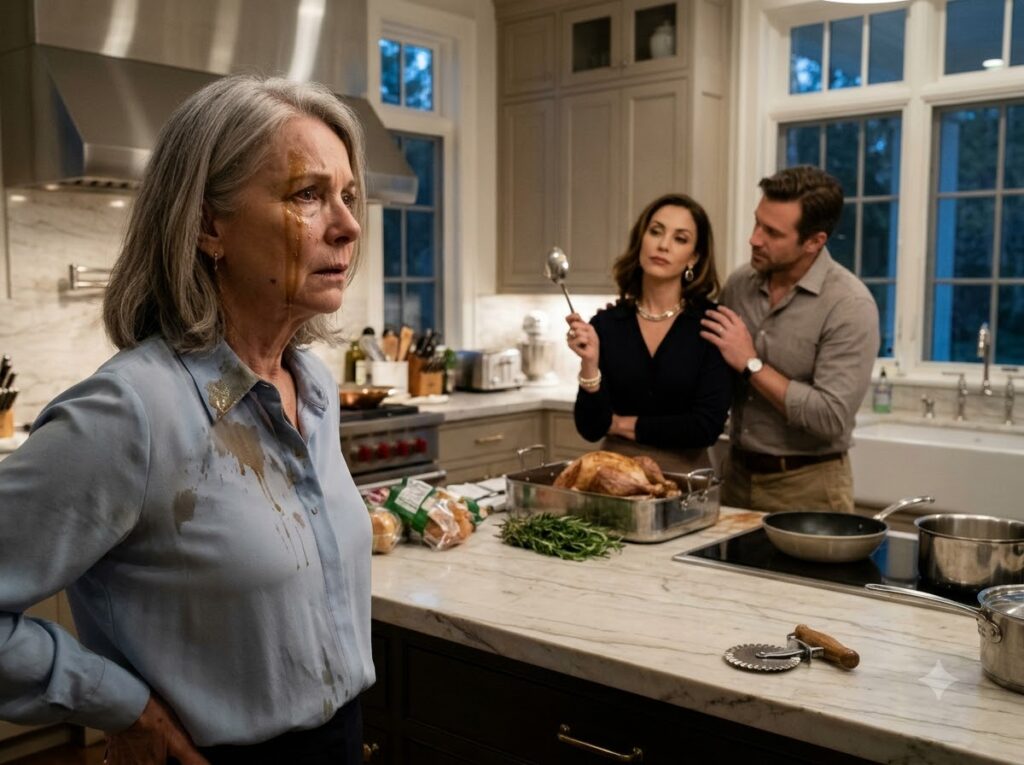
But as I looked at Daniel—my 32-year-old son, standing in his custom-tailored suit, his hand gently stroking the arm of the woman who had just spat food in my face—the illusion shattered.
“I asked for a demi-glace, not this rustic sludge,” Vanessa sneered, tossing the silver tasting spoon into the marble sink with a sharp clatter. “My father eats at Michelin-starred restaurants in Paris and Tokyo, Helen. You think he wants to eat something that tastes like it came out of a suburban diner? Fix it. You have thirty-five minutes.”
Daniel gave me a helpless, apologetic look, the kind of look a hostage gives his captor. But he wasn’t a hostage. He was a willing participant in my degradation.
“Just add some red wine and strain it, Mom, please?” Daniel whispered, checking his Rolex. “Richard is going to be here any minute, and this investment… it’s everything. It’s the next level for my company.”
His company.
I reached for a paper towel, slowly wiping the gravy from my face. I didn’t shout. I didn’t cry. A strange, glacial calm settled over my chest. It was the profound, liberating peace of a woman who has finally realized she has absolutely nothing left to lose, because the son she was trying to hold onto was already gone.
“Of course, Daniel,” I said, my voice shockingly steady. “I will fix it.”
Vanessa rolled her eyes, smoothing her immaculate, emerald-green silk dress. “And change your shirt. You look like a mess. I don’t want my parents thinking we employ sloppy help.”
We employ.
She turned on her heel and clicked out of the kitchen, her stiletto heels echoing against the hardwood floors. Daniel lingered for a fraction of a second. “Thank you, Mom,” he muttered, unable to meet my eyes, before rushing after his wife. “Babe, wait, let me pour you a drink before they get here…”
I stood alone in the massive, state-of-the-art kitchen. It was a kitchen I had paid for.
What Vanessa didn’t know—what Daniel had begged me to keep secret since the day he proposed to her—was the true nature of his “success.”
Five years ago, Daniel’s first real estate venture had collapsed spectacularly. He had been reckless, arrogant, and blind to the market. He was facing bankruptcy, lawsuits, and the complete destruction of his professional reputation. He had come to my small house, sat at my kitchen table, and wept like a child.
My husband, Arthur, had passed away three years prior, leaving me with a substantial life insurance policy, a robust stock portfolio, and our paid-off family home. I was supposed to travel. I was supposed to retire in comfort. Instead, I sold the family home, moved into a cramped two-bedroom apartment, and liquidated Arthur’s portfolio. I took every cent I had and formed a holding company: Arthur’s Legacy LLC.
Through that holding company, I bought Daniel’s bad debt. I injected three million dollars of capital into a new property development firm, Apex Zenith. I purchased the very house Daniel and Vanessa now lived in, putting it under the LLC’s name to protect it from his previous creditors.
I owned 60% of Apex Zenith. I owned the deed to the five-million-dollar estate they were currently standing in. Daniel owned 40% of the business, and he was, on paper, merely my employee—the CEO appointed to run the daily operations.
When Daniel met Vanessa, she was the daughter of Richard Vale, a billionaire venture capitalist. She was obsessed with status, wealth, and “self-made” men. Daniel, desperate to impress her, told her that he was the sole founder and owner of Apex Zenith. He told her he had bought the estate with his own hard-earned cash. He begged me to play along. “Just until we’re married, Mom,” he had pleaded. “Richard hates generational wealth and handouts. If Vanessa finds out you bailed me out, she’ll leave me. I’ll buy your shares back as soon as the company turns a real profit. I promise.”
I had agreed. I had signed a non-disclosure agreement drafted by his panicked lawyers, keeping my ownership a strict secret from the Vale family, hiding in the shadows while my son paraded as a self-made titan.
I looked down at my stained blouse. Arthur had bought me this blouse in Venice.
I took off my apron, walked to the guest bathroom down the hall, and carefully washed my face. I removed the stained blouse, folding it gently, and put on the spare black cashmere sweater I always kept in my tote bag. I looked at myself in the mirror. The weary, anxious mother who had arrived three hours ago was gone. Staring back at me was the majority shareholder of Apex Zenith.
I walked back into the kitchen, strained the gravy, added a splash of a five-hundred-dollar Cabernet Sauvignon Daniel had left on the counter, and let it simmer.
Then, the doorbell rang.
“Helen! Get the door!” Vanessa’s voice shrieked from the living room.
I walked into the grand foyer. Daniel was pacing nervously, adjusting his tie. Vanessa stood perfectly poised, a portrait of the gracious hostess. I pulled open the heavy oak double doors.
Richard Vale was a towering man in his late sixties, with silver hair, piercing blue eyes, and the rugged complexion of a man who had worked on construction sites before he ever wore a bespoke suit. Beside him was his wife, Eleanor, draped in understated cashmere and pearls.
“Mr. and Mrs. Vale,” Daniel beamed, stepping forward to shake Richard’s hand. “Welcome. Please, come in.”
“Daniel,” Richard said, his voice a deep, gravelly baritone. He gave a firm handshake, his eyes scanning the opulent foyer. “Beautiful home you have here. Vanessa talks about it constantly.”
“Daddy!” Vanessa glided forward, kissing her father on the cheek. “I’m so glad you made it. The traffic over the bridge must have been awful.”
“We left early,” Eleanor smiled, handing me her heavy wool coat without looking at me. “Thank you, dear.”
Popular Posts
→- 1
- 2
- 3
- 4




Recently Viewed
Stories you read recently will appear here.





