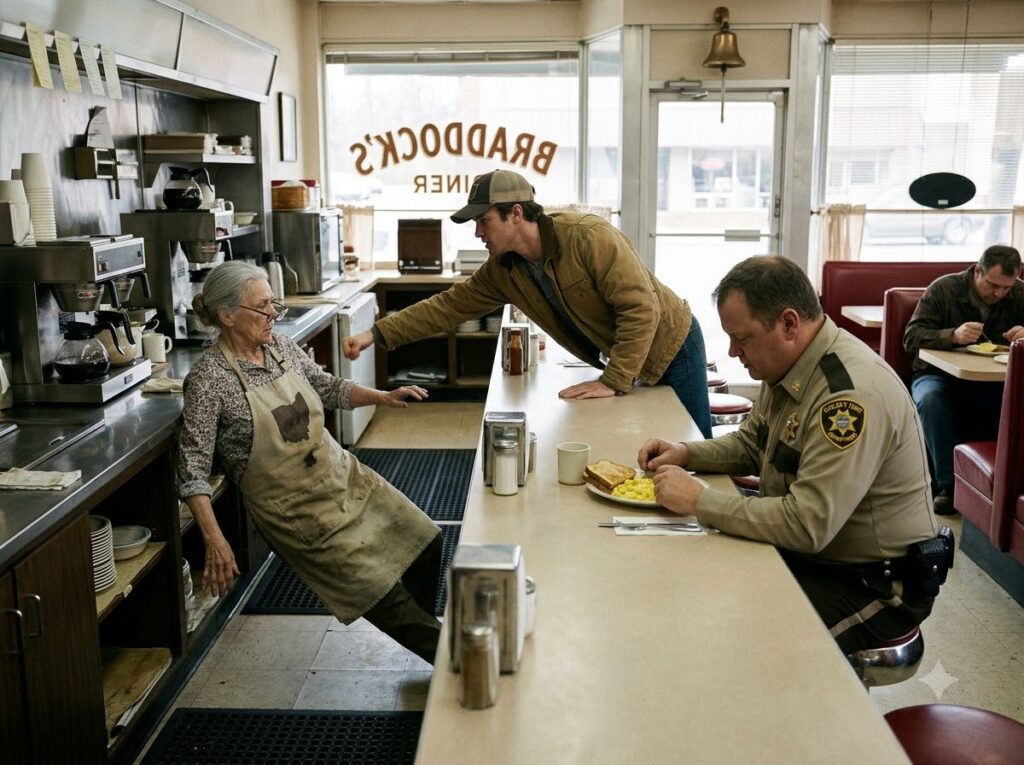
On the screen, old Man Higgins—who had eaten two eggs over easy at booth three every Tuesday since Nixon was in office—lifted his fork, poked a piece of rye toast into his yolk, and chewed. He didn’t look down. He didn’t lean over the mahogany partition to see if Lottie was breathing. He just chewed, swallowed, and took a sip of water from a plastic tumbler that had “Braddock’s Diner” faded off the side in white block letters.
Beside him, Sarah Miller—who had taught third grade to half the county, including Dalton Rusk and myself—kept her eyes fixed on her crossword puzzle. Her pencil hovered over a square for a second, scratched out an A, and wrote a U.
Behind the counter, Lottie’s hand came up first. Just the fingertips, trembling against the chrome toe-kick, testing for weight, trying to find purchase to push herself back up. Her silver hair had come loose from its bun, hanging like a gray question mark against her neck.
And then there was the sheriff.
Sheriff Tom Tolliver was sitting in booth one. Eleven feet away. Exactly eleven feet, because I’d scrubbed those linoleum tiles with a deck brush every Sunday afternoon from the time I was ten years old until I enlisted at eighteen. I knew the distance between every table, every stool, every crack in the grout.
Tolliver was wearing his Stetson on the edge of the bench seat. He had a plate of eggs Benedict half-eaten in front of him—the hollandaise sauce cooling into a skin. When Dalton Rusk swung his arm, Tolliver didn’t drop his fork. He didn’t jump up to read Miranda rights or cuff a man for assaulting a septuagenarian.
Instead, Tolliver slowly raised his coffee cup, blew a lazy curl of steam off the surface, and took a sip. His eyes didn’t even follow Lottie down. They flicked lazily to the door as Dalton Rusk straightened his jacket cuffs, adjusted his designer sunglasses, and walked out without a backward glance, the brass bell jingling a cheerful, mocking little tune.
“He called it a slip,” Mia whispered.
Mia was standing beside me in the hallway at Fort Liberty, holding her own phone. She was twenty-one, worked the double shift at Braddock’s on weekends, and had sent me the raw security file after downloading it from the local cloud storage before the sheriff’s department could seize the DVR. Her eyes were red-rimmed and fierce. “The report came out two hours ago, Quinn. Official report filed by Tolliver himself. ‘Subject tripped over floor mat while serving patron; no foul play suspected.’ They didn’t even interview Higgins or Sarah.”
My phone felt heavy in my palm. The screen was still glowing with the loop of my mother falling behind the counter she’d scrubbed bloody for half a century.
“Quinn?” the neighbor on the line was still talking. “Quinn, are you still there? Your mama’s at home now. She won’t go to the doctor. Says she’s fine, but she’s walking like she’s got glass in her hip. And Wade Rusk was by the shop this morning. Left a certified letter on the register. Second notice. Said if she doesn’t take the buyout by Friday, eminent domain through the county council is going to make her look like a beggar.”
“Tell her I’m coming home,” I said.
My voice didn’t shake. That was the funny thing about twelve years in the infantry and three deployments to places where the sand turned red when the sun went down—you learn how to pack your rage into a very small, very cold box in your chest. You lock the lid. You save it for when you actually need to use the tools.
“Quinn,” Mia said softly, touching my sleeve. “Wade owns everything out here now. The bank, the lumber yard, the judge. What are you going to do?”
I looked down at my boots—standard-issue brown leather, scuffed at the toe from an obstacle course two days ago.
“I’m going to make coffee,” I said.
PART 3: The Apron with Ohio
Cutler’s Ford hasn’t changed since 1998, except for the things that died.
The Sinclair station on the corner of Route 9 is a shell now, its windows starred with BB gun holes and posters for a county commissioner election that happened three years ago. The cotton mill closed down when I was twelve, leaving behind a brick carcass that the pigeons own. But Braddock’s Diner was still there, wedged between the hardware store and the Baptist church like an old tooth that refused to rot.
I didn’t call ahead. I didn’t stop by the sheriff’s station to ask questions. I drove straight down Main Street in my dented Ford Ranger, parked behind the diner by the grease trap, and walked through the back screen door.
The smell hit me first. It wasn’t just bacon and coffee. It was the specific, immutable smell of my childhood: lard, old-school Ajax, burnt toast crumbs in the bottom of the toaster slots, and Pledge on the Formica tables. It was the smell of my mother’s skin after she’d spent twelve hours bent over a flat-top grill.
Lottie was sitting on an overturned milk crate by the mop sink, rubbing her left hip with a yellow washcloth. She looked smaller than she had on FaceTime last Christmas. Her shoulders were rounded like she was carrying a sack of wet feed, and her hair was completely down, silver strands sticking to her damp temples.
When the screen door creaked, she flinched. She thought it was Dalton. Or one of Wade Rusk’s surveyors with another clipboard and another stack of papers that looked like a death warrant.
She looked up. Her eyes—faded blue, the color of washed denim—widowed wide.
“Quinn?” she whispered. The washcloth slipped from her fingers, landing in a puddle of soapy gray water by the drain. “Lord in heaven, what are you… you’re still active duty. You’ve got six months left on your contract—”
Popular Posts
→- 1
- 2
- 3
- 4




Recently Viewed
Stories you read recently will appear here.





