Trent’s fist struck Eleanor Hale before Rachel could finish closing the front door.
The sound was not loud. It was a flat, sickening crack that vanished into the high ceiling of the foyer, swallowed by polished marble, antique wood, and the whisper of rain against the tall windows.
Eleanor staggered sideways. Her hip struck the marble console, knocking a silver bowl onto the floor. Six suitcases stood behind Trent like silent witnesses, arranged near the entrance as though he and Rachel had already decided the house belonged to them.
Blood filled Eleanor’s mouth.
Rachel gasped, but she did not move.
For one suspended second, mother and daughter stared at each other.
Eleanor saw horror in Rachel’s face. She also saw fear—and something worse than fear. Obedience.
Trent flexed his hand as though Eleanor had injured him.
“I warned you not to embarrass me,” he said.
Eleanor pressed a linen napkin against her split lip. She had taken it from the console only moments earlier, intending to wipe rainwater from the brass plaque mounted beneath the family portrait.
The plaque read:
Hale House
Built 1928
Protected by those who remember
Trent had always mocked the final line.
Now Eleanor stood beneath it, breathing through the pain.
“We’re staying here for a month,” he repeated, pointing toward the hallway. “Rachel needs distance from everything that’s happened.”
“This is my home,” Eleanor answered. “You were not invited.”
His face changed.
It was a small change, invisible to anyone who had never lived near an angry man. His eyes flattened. His shoulders lowered. The corners of his mouth tightened.
Eleanor had seen it before.
Not directed at her, but at Rachel during Thanksgiving dinner two years earlier. Trent had dropped a serving spoon, and Rachel had flinched as though expecting a blow. Eleanor asked about it later. Rachel laughed too quickly and claimed she had been startled by the sound.
Eleanor had allowed herself to believe the lie.
Now Trent stepped closer.
“Say it again.”
“Get out of my house.”
His fist came without warning.
After Eleanor fell against the console, Rachel whispered, “Trent, stop.”
But she did not say it like a command. She said it like a prayer she expected God to ignore.
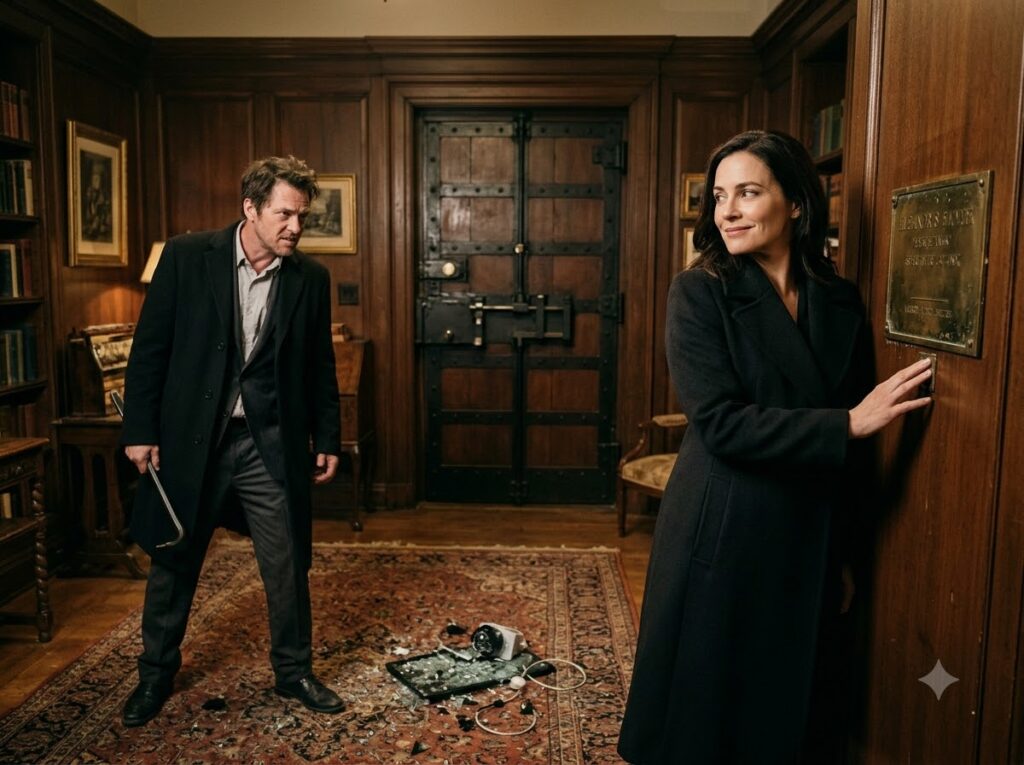
Eleanor raised her eyes toward the small security camera above the archway.
Trent followed her gaze.
He dragged a chair beneath it, tore the camera from its mount, and threw it onto the marble. Plastic cracked. A red light blinked once.
Then Trent crushed it beneath his shoe.
“No more evidence,” he said.
Rachel finally moved, but only to seize Eleanor’s phone from the console.
“Don’t make things any worse, Mom.”
Eleanor slowly straightened.
Blood marked the white napkin. Her lip throbbed. Her ribs ached where Trent’s shoulder had struck her during the confrontation.
Yet she smiled.
Not because she was unafraid.
Because Trent had noticed the camera.
He had not noticed the brass plaque.
Thirty years earlier, Eleanor’s husband had installed the first security system after a dismissed employee threatened their family. The technology had been updated many times, but one rule had never changed: the visible cameras were never the only cameras.
Eleanor rested two fingers against the lower corner of the plaque.
The hidden pressure switch clicked beneath her touch.
Somewhere inside the walls, an encrypted recording began transmitting to an off-site archive.
Trent’s triumphant expression faltered.
“What are you smiling about?”
Eleanor looked at the shattered camera, then at Rachel.
“You’ve made a mistake, you fool.”
The door behind them swung shut.
The electronic lock engaged with a soft mechanical sound.
Trent glanced over his shoulder.
Eleanor had not locked him in.
The house had.
Chapter One: The Sound of the Bolt
The heavy bronze latch didn’t just turn; it dropped into place with the final, heavy clunk of a vault door sealing a bank vault from the outside world.
In the center of the mahogany-paneled library, the dust motes hung suspended in the afternoon sunbeams slicing through the high, arched windows. Glass crunched softly beneath the sole of Victor Vance’s expensive Italian leather shoe as he stood over the wreckage of the tripod. The Nikon mirrorless camera body, which had cost more than most people’s monthly rent, was now a pathetic heap of magnesium alloy, fractured glass, and twisted circuit boards.
Victor shook his hand, wincing slightly where a jagged shard of UV filter had grazed his thumb. A dark droplet of blood swelled on his skin, bright and crimson against the pale backdrop of his manicured fingers.
“No more evidence,” he sneered, his chest heaving beneath his tailored cashmere vest. He looked up, his eyes wide and wild with the frantic adrenaline of a man who believed he was dismantling his final obstacle. He flashed a triumphant, ugly grin. “There. Done. No footage, no cloud backup, no digital trail. You think you’re so clever with your little historical preservation society, Eleanor? You’re just an old woman alone in an empty house.”
I didn’t flinch. I didn’t step back.
Sitting in my high-backed velvet armchair, with my hands folded neatly over the tartan wool blanket resting across my knees, I looked up at him. I wasn’t trembling. I wasn’t reaching for my phone. Instead, the corners of my mouth twitched upward into a quiet, slow smile—the kind of smile that makes a cornered animal realize it hasn’t caught its prey at all, but rather walked straight into a cage.
Victor’s triumphant sneer faltered. The color drained slightly from his cheeks.
“What are you smiling at?” he hissed, taking a sharp step forward. “Are you senile? Did you not just see me smash your proof to pieces?”
“Oh, Victor,” I murmured, my voice carrying the steady, unhurried cadence of a university professor correcting a particularly arrogant undergraduate. “You always were far better at spending money than you were at understanding systems. You spent six months trying to figure out how to strip the title from this estate, but you never bothered to learn how a house built in 1894 was actually engineered.”
Popular Posts
→- 1
- 2
- 3
- 4




Recently Viewed
Stories you read recently will appear here.





