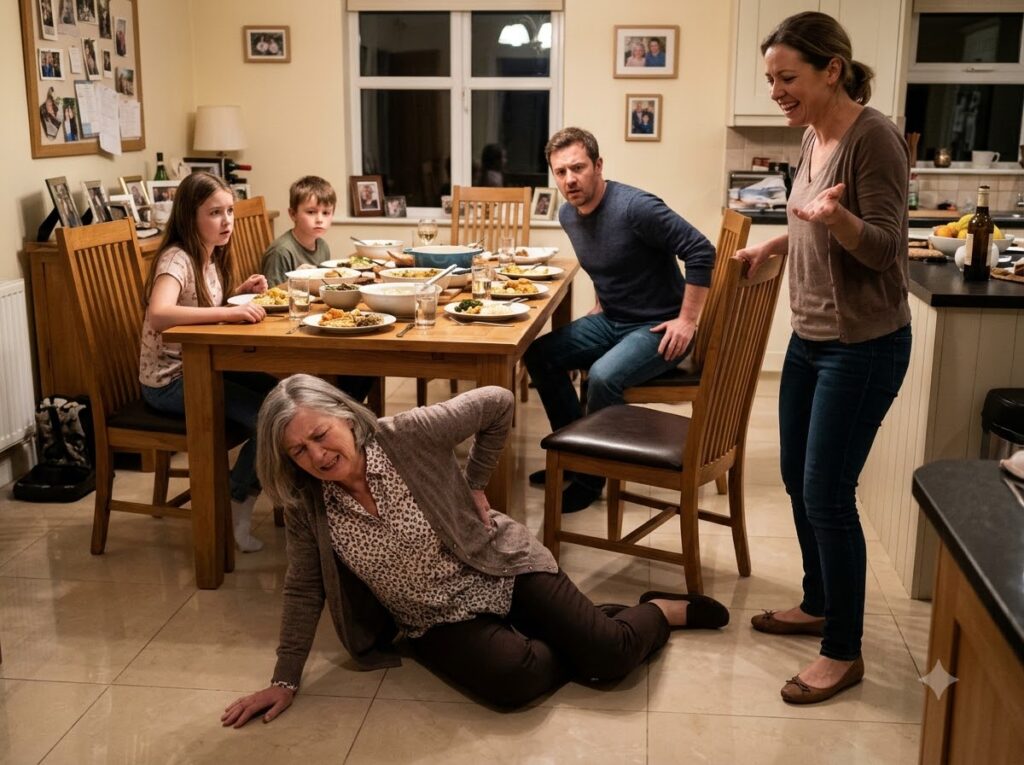
Every bump sent pain through my lower back.
The paramedic sitting beside me kept checking my blood pressure and asking how I felt.
I wanted to tell her I was embarrassed.
I wanted to tell her I felt foolish.
I wanted to explain that I wasn’t usually the kind of woman who made a scene at family dinners.
Instead, I said, “My hip hurts.”
She nodded.
“We’re going to have the hospital take a good look at it.”
I stared at the ceiling.
The ambulance smelled faintly of disinfectant and plastic.
I could hear equipment rattling softly as we turned a corner.
After a few minutes, the paramedic asked, “Do you mind if I ask you something?”
“No.”
“Did you say someone moved the chair while you were sitting down?”
I swallowed.
“Yes.”
“Did you know the chair was being moved?”
“No.”
She made a note.
“All right.”
I watched her for a moment.
Then I said, “My daughter-in-law thought it would be funny.”
She looked at me.
There was no judgment on her face.
Only concern.
“Well,” she said gently, “I’m sorry that happened to you.”
Such a simple sentence.
But it brought tears to my eyes.
I turned my face away.
I wasn’t crying because a stranger had been especially kind.
I was crying because she had believed me without asking me to explain Rachel’s intentions.
She hadn’t said Rachel was probably having a bad day.
She hadn’t suggested I’d misunderstood.
She hadn’t told me that families sometimes joke too much.
She’d simply heard what happened and recognized that it was wrong.
I had forgotten what that felt like.
At the hospital, everything happened in short, confusing stages.
A nurse asked about my medications and whether I’d ever had trouble with my hip before.
A doctor examined me.
They took X-rays.
Then they ordered additional imaging because I still had significant pain around my pelvis and lower back.
I answered questions as carefully as I could.
My mind kept drifting back to Lily.
Her small hand gripping Daniel’s sleeve.
Her frightened voice.
Mom did it on purpose.
I wondered how long she’d been carrying those words.
Had she stood in the hallway all through dinner preparation, trying to decide whether to warn me?
Had she thought about telling her father?
Had she been afraid her mother would get angry?
I remembered how she had looked at my chair.
I remembered her silence when Rachel told her to wash her hands.
I remembered the strange seriousness in her eyes that afternoon.
And suddenly I understood why she’d asked me whether Rachel knew her comments were hurtful.
My granddaughter hadn’t been asking a childish question.
She’d been trying to understand behavior that the adults around her kept excusing.
That realization hurt in a different way.
For years, I had told myself that staying quiet protected Daniel and the children.
But Lily had been watching.
She had heard the remarks.
She had seen me smile when I was hurt.
And she had watched her father try to make everyone get along.
I wondered what lesson we had been teaching her.
That being loved meant accepting humiliation?
That being kind meant never objecting?
That if someone said something cruel with a smile, the person they hurt was supposed to smile too?
I pressed my hands together on the hospital blanket.
I hadn’t meant to teach her any of those things.
But intentions, I was beginning to understand, weren’t always the same as consequences.
Daniel arrived while I was waiting for the results of my scans.
I knew he was there before I saw him.
I heard his voice at the nurses’ station.
He sounded strained.
“She’s my mother. She came in by ambulance.”
A minute later, he appeared in the doorway.
His jacket was half-zipped.
His hair was disheveled.
And he looked ten years older than he had that morning.
“Mom.”
I managed a smile.
“Hello, sweetheart.”
He crossed the room in three steps.
“How are you?”
“Sore.”
He pulled a chair close to my bed.
“Did they say anything?”
“They’re waiting on some pictures.”
He nodded.
Then he looked down at his hands.
I noticed they were trembling.
“Where are the children?” I asked.
“Mark and his wife have them next door for a little while. I checked on them before I left. I’ll get them home once I know you’re all right.”
“And Rachel?”
His face changed.
“She’s gone.”
I studied him.
“What do you mean?”
“She left with Megan.”
I didn’t know what to say.
He rubbed his forehead.
“I told her to go. Megan took her.”
“Daniel—”
“Mom, please.”
He lifted his eyes to mine.
“Please don’t ask me to bring her back tonight.”
I went quiet.
Because that was exactly what I had been about to do.
Not because I wanted Rachel back in the house.
Not because I thought she deserved to be forgiven.
But because I was worried about what her absence would do to everyone else.
Daniel seemed to read my thoughts.
“You don’t need to fix this.”
I stared at him.
He leaned forward.
“You’ve been doing that for years, haven’t you?”
My throat tightened.
“I don’t know what you mean.”
He gave a sad little shake of his head.
“Yes, you do.”
For a moment, neither of us spoke.
Then he asked a question that frightened me more than I expected.
“How long have you been unhappy coming to our house?”
I looked at the blanket.
There are questions that sound simple until someone asks them at the exact moment you’re no longer able to lie.
That was one of them.
“Daniel…”
“Please tell me.”
I folded my hands together.
“I love seeing you and the children.”
“That’s not what I asked.”
I felt the familiar urge to reassure him.
To tell him he was a wonderful son.
To insist that it wasn’t a big deal.
But the memory of Lily’s face stopped me.
I took a breath.
“Quite a while.”
Popular Posts
→- 1
- 2
- 3
- 4




Recently Viewed
Stories you read recently will appear here.





