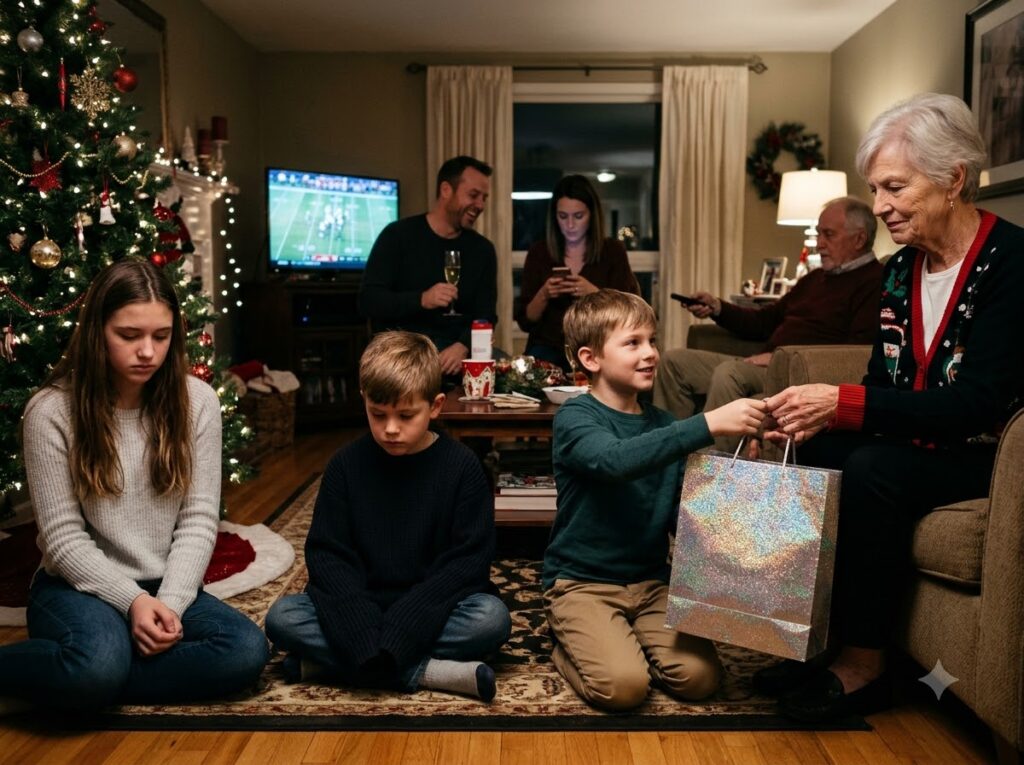
I looked at my mother. I looked at the woman who had spent thirty-four years subtly dismantling my confidence, piece by piece, through backhanded compliments and conditional affection. For thirty-four years, I had absorbed it. I had rationalized it. I had told myself it was just her generation, just her way, just a personality clash. But as I watched a tear finally spill over Emma’s lower lash line and track a silent, shiny path down her eight-year-old cheek, the illusion shattered. The desperate, pleading daughter inside me died instantly, replaced entirely by a mother who had just watched her children be thrown to the wolves for sport.
I did not scream. I did not throw my glass of sparkling cider against the brick fireplace. I simply stood up.
“Emma, Noah. Coats. Now.”
My voice was not loud, but it cut through the room with a serrated edge. Brent paused with his champagne flute halfway to his mouth. My father finally tore his eyes away from the football game, blinking in confusion.
“Oh, for heaven’s sake, don’t be so dramatic,” my mother sighed, waving a dismissive, manicured hand in the air. “It’s just a misunderstanding with the shopping list. Tyler is the only boy, and I wanted to make sure he had something special. Your two have enough toys at home. You spoil them rotten anyway.”
“Coats,” I repeated to my children, ignoring her completely.
Noah, ten years old and trying desperately to be the man of the house since my husband passed away three years ago, scrambled to his feet. He grabbed Emma’s hand, his small jaw set tight, and pulled her toward the hallway.
“You’re leaving?” Brent asked, a mocking lilt in his voice. “Before midnight? Come on, sis. Tyler was just making a joke. Don’t be so sensitive. You’re ruining the party.”
I walked over to the velvet armchair where my purse rested. I picked it up, slinging the strap over my shoulder, and finally looked my brother dead in the eye. “Enjoy your champagne, Brent. Enjoy the house. Enjoy all of it.”
I walked out the front door without looking back. The freezing December air hit my face like a physical blow, shocking my system out of the suffocating heat of that living room. The driveway was slick with black ice, and the sky was a heavy, starless black. I buckled Emma into the back seat of my SUV, wiping the tear from her cheek with my thumb, and waited for Noah to climb in beside her.
I started the engine and pulled out of the neighborhood, the grand, illuminated mansions of my parents’ subdivision fading into the rearview mirror. For ten minutes, the only sound in the car was the hum of the heater and the soft, rhythmic swish of the windshield wipers clearing a light dusting of snow.
Then, Noah spoke from the darkness of the backseat.
“Mom, did we do something wrong?”
The question fractured my heart into a thousand jagged pieces. I pulled the car over to the shoulder of the empty suburban road, throwing it into park. I unbuckled my seatbelt and turned around, reaching into the back to take both of their cold, small hands in mine.
“Listen to me,” I said fiercely, making sure they both looked me in the eyes. “You did absolutely nothing wrong. You are perfect. You are kind, you are smart, and you are the best things that have ever happened to me. What happened in that house tonight had nothing to do with you. It is about adults who are broken, cruel, and small. Do you understand me? You never, ever let anyone make you feel like you have to earn your place in a room.”
Emma nodded, sniffing softly, and Noah squeezed my hand. I turned back around, put the car in drive, and headed home. By the time I carried them up to their beds, they were asleep, exhausted by the emotional toll of the evening. I tucked the heavy quilts around them, kissed their foreheads, and closed their doors.
It was 11:15 P.M.
I walked downstairs to my home office. I turned on the desk lamp, the warm light pooling over the polished mahogany surface. I booted up my laptop, pulled out a thick ledger from my bottom drawer, and poured myself a glass of water.
My mother and brother believed they held the power because they held the social capital of our family. They believed they were untouchable because they carried the arrogance of old money and established status. What they conveniently chose to forget, day after day, year after year, was that the old money was gone.
My father had quietly bankrupted the family business a decade ago through terrible investments and a gambling problem he successfully hid from the country club. When the creditors had come knocking, he had come to me. Not to Brent, his golden boy who was busy burning through trust funds and playing pretend as a real estate developer, but to me—the quiet, overlooked daughter who had taken her inheritance early, invested it in a tech startup, and built a multimillion-dollar logistics empire.
I had saved them. I had bought the mortgage to the sprawling estate they lived in, hiding my ownership behind a blind trust to save my father’s fragile pride. I had placed Brent on my company’s payroll as a “senior consultant,” a phantom role that paid him a ridiculous salary to do absolutely nothing, simply because my mother had cried and begged me to ensure her boy was taken care of. I paid for Tyler’s private school tuition. I paid the lease on my mother’s Mercedes.
I had subsidized their arrogant, lavish delusions for ten years, hoping that if I just gave them enough, protected them enough, they would finally look at me—and my children—with genuine love.
Tonight, the ledger was closing.
I opened my email and began to type. My attorney, Marcus, was a ruthless corporate litigator who worked the same ungodly hours I did. I knew he was awake.
Popular Posts
→- 1
- 2
- 3
- 4




Recently Viewed
Stories you read recently will appear here.





