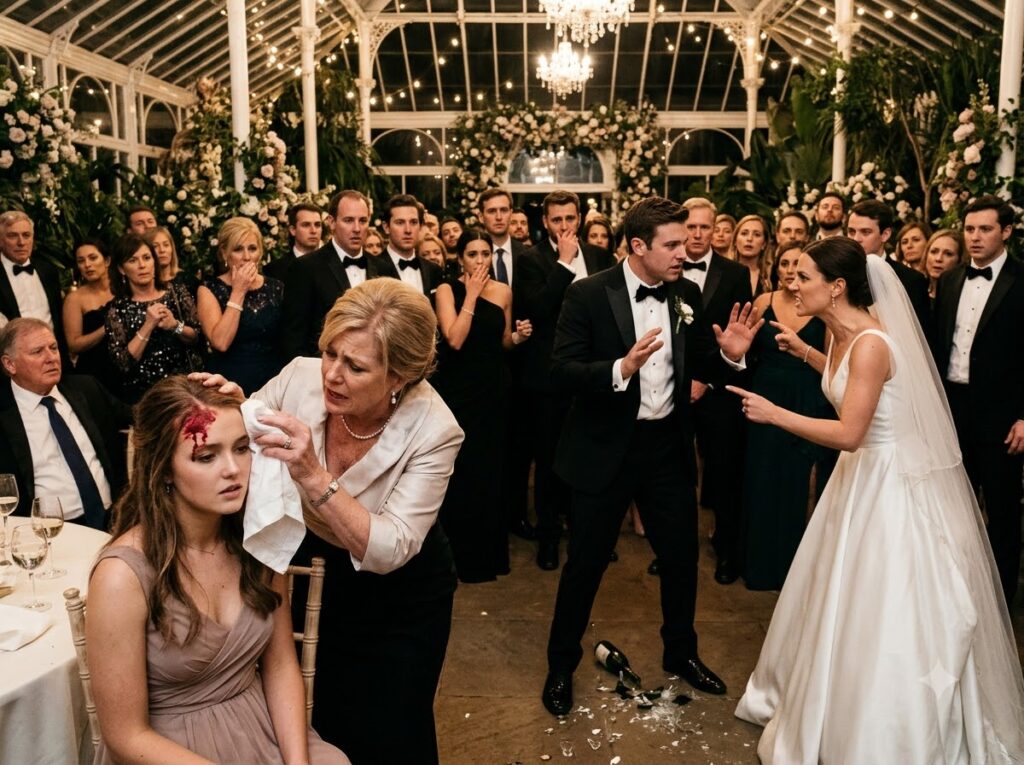
“She is bleeding,” Claire said, her voice dropping to a low, dangerous whisper that cut through the murmurs of the wedding guests. She stepped toward Ethan, the train of her immaculate silk gown dragging through the puddle of spilled champagne and shattered glass. “You hit your sister in the head with a real bottle, Ethan. What is wrong with you?”
“It was supposed to be a sugar-glass prop!” Ethan protested, his hands defensively raised, his eyes darting around the room to gauge the audience. “The groomsmen and I set it up. Someone must have swapped it! It’s a prank, Claire, come on. It’s for the wedding video. You’re overreacting.”
“I am overreacting?” Claire turned to look at me.
My vision was swimming. The edges of the conservatory—the sprawling ferns, the hanging wisteria, the crystal chandeliers—were blurring into a sickening, smeared canvas of light and color. The metallic scent of my own blood was overpowering the fragrance of the floral arrangements. I could feel the warm, thick liquid sliding past my ear, trailing down my neck, and staining the collar of my pale blue bridesmaid dress.
“Mom,” I choked out, pushing her hands away. Her manicured nails were digging into my scalp, and her desperate attempts to cover the wound were only causing agonizing bursts of pain.
“Just keep pressure on it, sweetheart,” my mother hissed, leaning in close so only I could hear. “Don’t make a scene. The photographer is right over there. Go to the powder room, clean it up, and we can put some concealer on it. It’s just a little cut.”
I looked at her, truly looked at her, and saw the absolute emptiness behind her panicked eyes. She wasn’t worried about my skull being fractured. She was terrified that her perfect son’s perfect wedding was being derailed by my inconvenient bleeding.
“I need a hospital,” I said, my voice sounding hollow and distant to my own ears.
“I’ll take you,” Claire said instantly, stepping away from Ethan.
“No, you will not,” Ethan snapped, grabbing Claire’s arm. “You are the bride. We have the cake cutting in ten minutes. She can take an Uber. It’s a scratch.”
Claire looked down at the hand gripping her arm, then back up at the man she had just sworn her life to. I saw something fundamental snap behind her eyes. It was the brutal, instantaneous death of an illusion. She ripped her arm away from his grasp.
“Do not touch me,” Claire said, her voice shaking with rage. She turned to her maid of honor. “Call an ambulance.”
“No ambulance!” my mother shrieked, finally dropping the bloody napkin. “Do you know how that will look? Sirens pulling up to the estate? Ethan, go get the valet to bring her car around. She can drive herself.”
The nausea hit me in a violent wave. I didn’t wait for the valet. I didn’t wait for another excuse. I turned on my heel and walked away. The silence of the guests was suffocating, a heavy curtain of judgment and shock that parted only to let me stumble through. I pushed through the heavy oak doors of the country club, the cool night air hitting my face like a physical shock. I bypassed my own car—there was no way I could drive with the world spinning on a tilted axis—and collapsed into the back of a waiting rideshare that had just dropped off late-arriving guests.
The driver took one look at my blood-soaked dress in the rearview mirror, slammed the car into gear, and sped toward the nearest emergency room without me having to say a word.
The hospital was a glaring assault of fluorescent lights, the sharp smell of antiseptic, and the chaotic hum of trauma nurses. By the time they got me onto a gurney, the adrenaline had worn off, leaving behind a pounding, blinding agony behind my eyes. I answered their concussion protocol questions in a daze. My name is Maya. I am twenty-eight. It is Saturday. My brother hit me with a glass bottle.
A doctor with kind, tired eyes introduced himself as Dr. Aris. He gently stabilized my head and began the meticulous process of clearing the shattered glass from the laceration above my right ear. The local anesthetic burned fiercely before the blessed numbness set in.
“You have a minor concussion, Maya,” Dr. Aris said, his gloved hands working with precision. “The cut is deep. I’m going to have to shave a small patch of hair to properly irrigate the wound and place the sutures. You have a few shards embedded in the tissue.”
“Do whatever you have to do,” I whispered, staring blindly at the acoustic tiles on the ceiling.
I felt the gentle buzz of the clippers, followed by the cold rush of saline solution washing over my scalp. Then came the metallic click of tweezers. I heard a tiny clink as a piece of glass was dropped into the stainless steel kidney basin resting near my shoulder. Then another clink.
Then, the doctor stopped.
The rhythmic, comforting motion of his hands ceased entirely. The silence in the small trauma bay stretched out, thick and heavy.
“Doctor?” I asked, my voice slurring slightly from the exhaustion.
He didn’t answer immediately. He leaned in closer, adjusting the intense overhead surgical light. I felt the tweezers grip something deep within the laceration, something that resisted slightly before pulling free. It didn’t sound like glass when he dropped it into the metal basin. It sounded heavier. Denser.
Dr. Aris pulled back. He pulled his surgical mask down, his brow furrowed in profound confusion. He picked up the basin and brought it into my line of sight.
“Maya,” he said slowly, his voice laced with a deep, unsettling caution. “Do you know what this is?”
I forced my eyes to focus. Resting amidst the bloody gauze and jagged fragments of green glass was a small, perfectly cylindrical object. It was no larger than a grain of rice, encased in a smooth, dark titanium shell. It had clearly been dislodged by the impact of the bottle, ripped from whatever subdermal pocket it had been resting in.
Popular Posts
→- 1
- 2
- 3
- 4




Recently Viewed
Stories you read recently will appear here.





