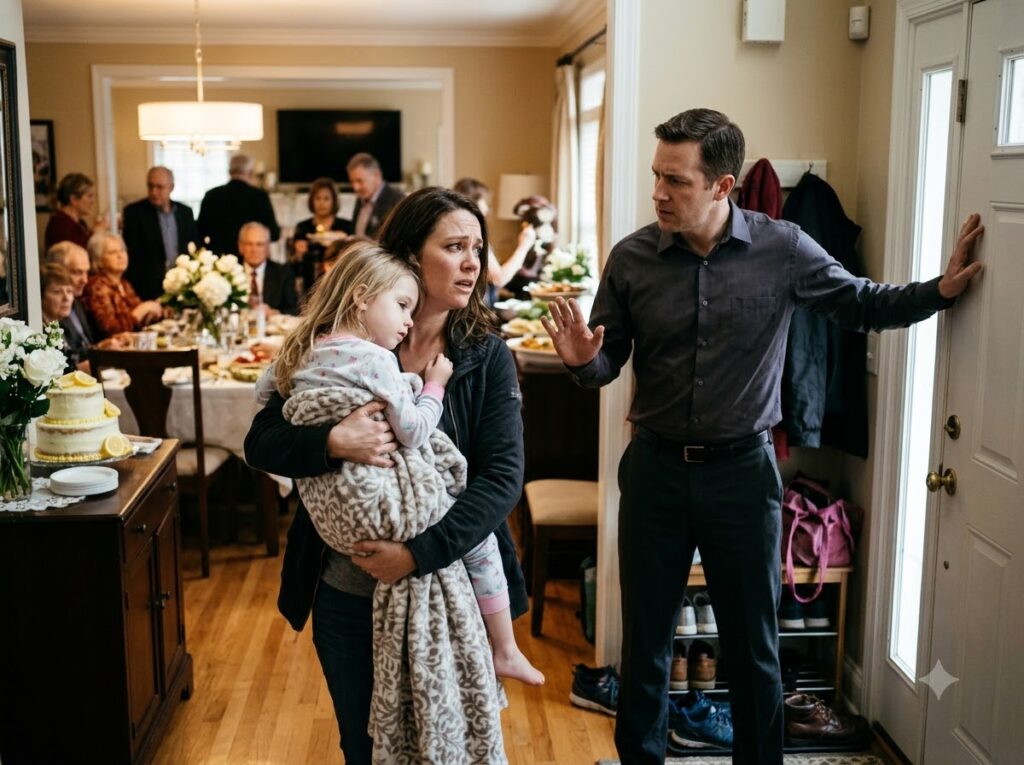
Then, Ava made a sound. It wasn’t a cry; it was a terrifying, hollow rattle deep in her chest.
I looked down just as her eyes rolled back into her head. Her small, burning body went completely rigid, and she slipped from my grasp, collapsing onto the hardwood floor in a violent seizure.
The sight of my daughter convulsing shattered the ice in my veins. The subservient, peace-keeping wife I had been for seven years vanished, replaced entirely by something primal and cold.
“Don’t touch her!” Mark hissed, dropping to his knees, reaching out as if to cover her mouth, to muffle the terrible slapping sound her small shoes were making against the floorboards. “If you scream, you’ll ruin the dinner. I’ll put her in the bathtub. It’s just a fever spike.”
He was trying to hide her.
I didn’t think. I reacted. I grabbed the heavy brass umbrella stand beside the front door and swung it with every ounce of strength I possessed. It caught Mark squarely in the shoulder. He roared in pain, sprawling backward onto the rug. I didn’t wait for him to recover. I scooped Ava’s convulsing body into my arms, kicked the deadbolt open, and ran out into the freezing night air.
I didn’t have my purse. I didn’t have her shoes. I just ran to my car, threw open the back door, and laid her on the seat. I fumbled for the spare key I kept hidden in the wheel well, my fingers tearing on the cold metal. By the time Mark burst through the front door, shouting my name, the engine was roaring to life. I threw the car into reverse, tires screeching across the manicured lawn, and sped into the darkness.
The drive to the pediatric emergency room took nine minutes. I don’t remember breathing for a single one of them. Ava’s seizure had stopped, but she was entirely unresponsive, a terrifyingly limp weight in my arms when I carried her through the sliding glass doors of the ER, screaming for help.
Nurses swarmed us. They took her from my arms, laying her on a gurney and rushing her behind double doors. A flurry of medical jargon filled the air—stat labs, lumbar puncture, broad-spectrum antibiotics, fluid bolus. I stood in the hallway, my shirt stained with her vomit, my cheek throbbing, completely numb.
An hour passed in a sterile waiting room. Then two.
When the attending physician, a stern-faced woman named Dr. Evans, finally walked in, her expression was grim, but it wasn’t the look of a doctor delivering news of a natural tragedy. It was the look of a detective.
“Your daughter is stabilized,” Dr. Evans said, closing the door behind her. “Her fever is coming down. But Mrs. Vance, I need you to listen to me very carefully. Ava does not have meningitis. She does not have an infection.”
I stared at her, the room spinning. “But her neck… the fever…”
“Those are neurological responses,” Dr. Evans interrupted gently. “We rushed a toxicology screen because her pupil dilation and heart arrhythmia didn’t match a standard viral or bacterial profile. Ava is suffering from acute organophosphate poisoning. It’s a highly toxic chemical compound, typically found in high-grade industrial pesticides. But based on the concentration in her blood, she didn’t just stumble into a garage and touch it. She ingested it. Recently, and in a significant dose.”
The words hung in the air, heavy and suffocating. Pesticide.
“That’s impossible,” I whispered. “We don’t use pesticides. Mark is obsessed with organic gardening. We don’t even have weed killer in the garage.”
“Who was with her today?” Dr. Evans asked, her voice dropping lower. “Who prepared her food?”
The realization hit me with the force of a physical blow. The puzzle pieces I had been ignoring for months suddenly snapped together, forming a picture so horrific my knees gave out. I sank into the plastic waiting room chair, gasping for air.
Mark’s mother, Diane, had arrived four days ago for her retirement celebration. Diane was a former botanist who had spent her career consulting for large-scale agricultural firms. She despised me. She had always made it clear I was entirely beneath her son, a mistake he had made in his youth. But over the last four days, she had been remarkably sweet to Ava. She had insisted on making Ava her “special health shakes” every morning.
And Mark. Mark, who had been fiercely protective of Ava her entire life, had suddenly become dismissive of her symptoms all afternoon. Mark, who stood in front of the door and slapped me. Mark, who looked at me not with panic, but with cold, calculated desperation to keep me away from a hospital.
He understood far more than I did. He didn’t want to stop me from ruining the party. He wanted to stop me from getting a blood test.
“My husband,” I choked out, looking up at the doctor. “My husband and his mother.”
Dr. Evans didn’t ask for clarification. She picked up the wall phone. “I’m calling the police. I need you to stay in this room.”
The arrival of the authorities was swift. I gave my statement to two detectives, detailing the shakes, the slap, Mark’s violent refusal to let me leave, and Diane’s background in agricultural chemicals. The police dispatched a unit to our house immediately.
I sat by Ava’s hospital bed for the rest of the night. She was hooked up to a tangle of wires and IVs, her small chest rising and falling rhythmically. I held her hand, crying silently, mourning the absolute death of my marriage and the chilling reality of the man I had slept next to for seven years.
By sunrise, Detective Miller returned to the hospital.
“We arrested them both at the house,” he said, taking off his hat. “The party was still going on. We found a vial of concentrated organophosphates hidden in Diane’s travel bag. Mark confessed during the ride to the precinct.”
Popular Posts
→- 1
- 2
- 3
- 4




Recently Viewed
Stories you read recently will appear here.





