The rain had begun falling in thick, grey sheets over the Coast Range by the time I cleared the highway summit, but my foot stayed pressed heavy against the accelerator. On the passenger seat of my sedan sat my phone, dark and silent since twelve forty-two that afternoon. That was when my mother, Irene Sinclair, had whispered seven fractured words into the receiver before the connection was violently severed: “Lucas… sweetheart… maybe you should come.”
There had been no goodbye, no explanation, only the faint, metallic scrape of an object skittering across hardwood and a man’s harsh, muffled bark in the background. My mother was seventy-two years old. She had survived breast cancer, forty-eight years of standing on concrete floors as a county librarian, and five decades of pinching pennies so thin they practically turned to dust. She did not panic. She did not whisper. And she never, under any circumstance, hung up on her son.
I pushed the car harder through the mist, the wipers beating an erratic tempo against the glass.
Three weeks earlier, that stretch of Highway 26 had felt like the pathway to a dream. On the first Saturday of October, my parents had celebrated their fiftieth wedding anniversary. They hadn’t wanted a banquet hall or a caterer. My father, Samuel, had spent forty-three years operating heavy machinery for the state road department, waking up at four in the morning in the bitter freeze of Oregon winters, wearing flannel shirts mended three times over until the fabric gave out completely. When I graduated with my master’s degree in civil engineering, Dad had quietly slipped an envelope containing fifteen thousand dollars into my coat pocket—an amount that represented every single dollar he had earned working weekend shifts clearing landslides. He had refused to let me pay him back.
So when my commercial development firm in Portland had its first monumental year, I did not buy myself an exotic car or an oversized penthouse. I drove out to Cannon Beach, found a three-story, cedar-shingled oceanfront home nestled against the dunes with panoramic views of the Pacific, and paid for it outright.
I remembered the look on Dad’s weathered face the morning I handed him the brass key. He had walked out onto the wraparound deck, his rough, calloused hands gripping the white railing so hard his knuckles turned white. The ocean breeze had ruffled his thinning grey hair, and for five minutes, he hadn’t been able to speak at all. Mom had pressed her forehead against my shoulder, weeping softly into my jacket.
“You’ve done too much for us, Lucas,” she had murmured through her tears.
“No,” I had told her, holding her frail shoulders. “You gave me a life. The least I can do is give you the ocean.”
Yet behind that generosity lay a very specific, deliberate wall of legal protection. I knew my family. Specifically, I knew my older sister, Fiona, and the man she had married twelve years ago, Gregory Vance. Gregory was a failed general contractor whose life was a continuous loop of defaulted business loans, grand schemes that evaporated into lawsuits, and an intoxicating sense of unearned entitlement. Fiona lived in Gregory’s shadow, adopting his toxic worldview that the universe owed them luxury simply for existing.
Because of that, when the transaction closed with the title company, the property was registered under my single-member LLC, Sinclair Holdings. My parents were granted a formal, lifetime occupancy agreement filed with the county clerk, guaranteeing them unconditional residence for as long as they lived, free of taxes, maintenance burdens, or risk. Neither Fiona, nor Gregory, nor any debt collector could touch a single splinter of that wood. To my parents, I had kept the conversation simple: the house was theirs to enjoy forever, and all the administrative headaches remained entirely mine.
For three weeks, paradise had held. Mom sent me daily photos of her morning tea on the deck. Dad sent me pictures of driftwood he had collected on his morning walks.
Then Fiona called them.
She had claimed that she and Gregory were under immense stress, that their teenage sons, Hunter and Mason, desperately needed fresh ocean air after a difficult school semester. “Just three or four days, Mom,” Fiona had coaxed over the speakerphone while I happened to be visiting for Sunday brunch. “Just a quick weekend to unwind.”
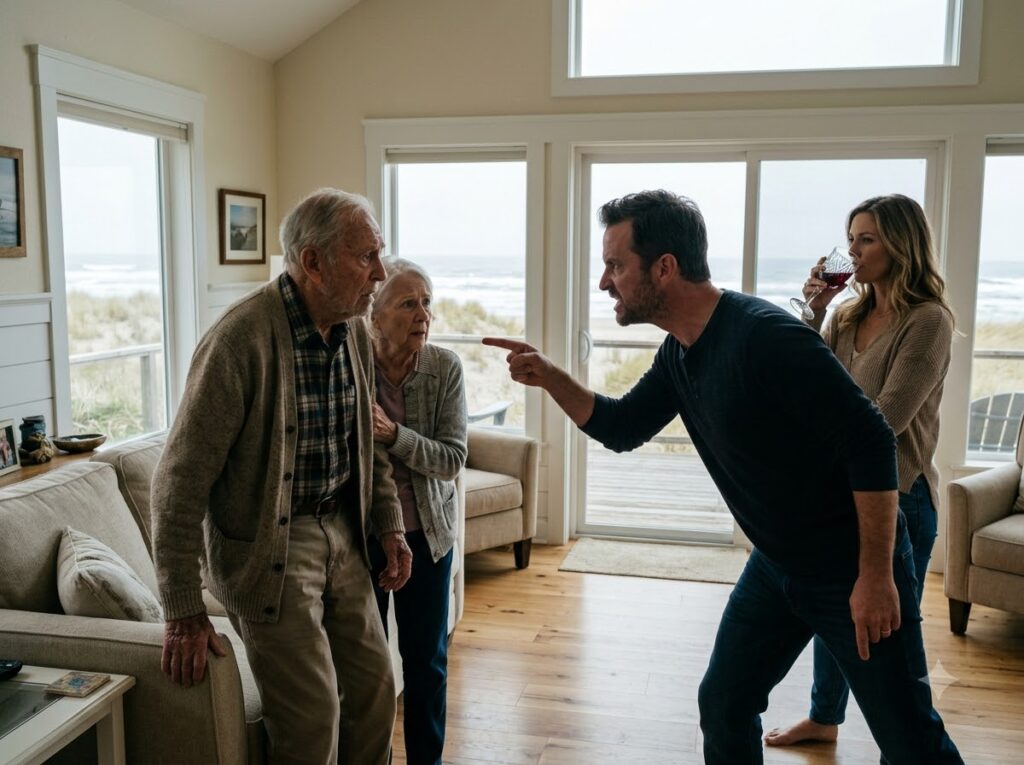
Il marito di mia sorella ha messo alle strette mio padre tremante chiedendogli di firmare la rinuncia alla casa sul mare
Mio padre, il cui cuore generoso era la sua più grande vulnerabilità, aveva sorriso e aveva detto: “Certo, tesoro. Ci sono quattro camere da letto. Vieni quando vuoi.”
Un weekend si trasformò in dieci giorni. Dieci giorni divennero due settimane. Le foto allegre del mattino si fermarono. Quando ho chiamato mia madre giovedì scorso, le sue risposte erano esitanti, guardinghe, come se parlasse con una mano a coppa sul bocchino. Mi disse che i ragazzi erano rumorosi, che Gregory aveva invitato diversi suoi conoscenti d’affari fuori città a bere qualcosa fino a tarda notte, e che si sentiva una sconosciuta nella sua stessa cucina.
E poi arrivò la linea di morte alle dodici quarantadue.
Le gomme schizzavano nell’acqua stagnante mentre uscivo dall’autostrada costiera su Hemlock Street, poi guidavo l’auto lungo la stretta strada ghiaiosa che curvava verso il cul-de-sac privato.
Nel momento in cui la casa apparve davanti, lo stomaco mi si contorse in un nodo duro e freddo.
Il pickup nero sovradimensionato e sollevato di Gregory era parcheggiato diagonalmente dall’altra parte del vialetto, il paraurti anteriore schiacciava le ortensie appena piantate da mia madre contro il muro di contenimento di pietra. Un rimorchio utilitario a doppio asse arrugginito era parcheggiato sul prato curato, lasciando profonde solchi marroni nel pavimento. Lattine di birra vuote e scatole di cartone zuppe erano sparse lungo il sentiero. Sul portico avvolgente al secondo piano, asciugamani bagnati e tavole da surf abbandonate pendevano disordinatamente sopra le ringhiere personalizzate.
Popular Posts
→- 1
- 2
- 3
- 4




Recently Viewed
Stories you read recently will appear here.





