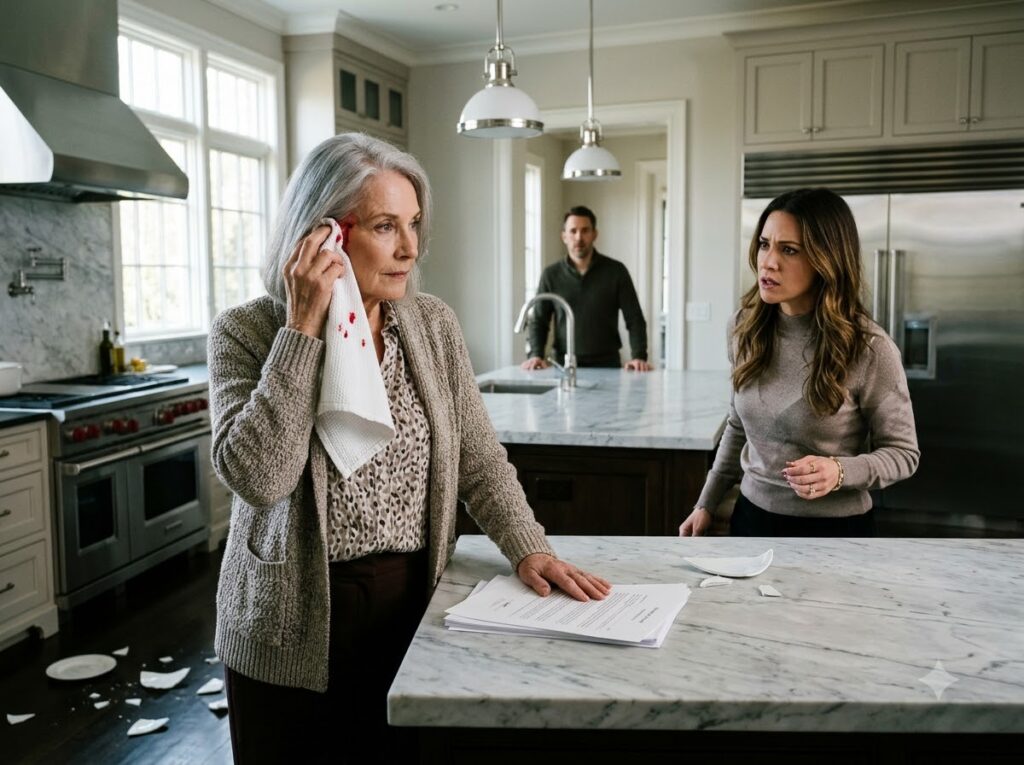
I kept the towel pressed firmly against my temple. The sharp sting of the cut was grounding, pulling all the lingering, maternal fog from my brain. For forty years, I had made excuses for the men in my life. I had smoothed over my late husband’s financial blunders, and I had quietly subsidized my son’s lifestyle out of a misguided sense of duty. I had bought this sprawling, five-bedroom house in the suburbs of Chicago when David’s tech startup failed, allowing him and Vanessa to live rent-free so they could “get back on their feet.”
That was six years ago.
“Provoke her,” I repeated, tasting the metallic tang of adrenaline in the back of my throat. I looked at the blood seeping through the white linen of the dish towel. “By refusing to sign away the property my grandfather built with his own hands? Is that what constitutes provocation in this house, David?”
Vanessa crossed her arms, her chest heaving, the heavy diamond solitaire on her finger catching the light from the recessed fixtures I had paid to install. She had recovered from her momentary shock and was quickly constructing her defensive reality. “You tripped, Eleanor,” she said, her voice dropping into a terrifyingly calm, even cadence. “You tripped and hit your head on the edge of the granite countertop. David saw it. Didn’t you, David?”
She turned her sharp, calculating gaze to my son. David swallowed hard, his Adam’s apple bobbing. He looked at the shattered plate on the floor, then at the blood on my face, and finally at the woman who controlled his every waking breath.
“Yeah,” David mumbled, staring at the floorboards. “You lost your balance, Mom. We should get you some ice.”
A profound, absolute silence settled over the kitchen. It was the sound of a cord snapping—the invisible, resilient thread that binds a mother to her child. In that singular moment, I did not see my little boy anymore. I saw a coward. And I saw the parasite he had married.
“There will be no ice,” I said. I reached down with my free hand and picked up the unsigned transfer papers for the lake property. A drop of my blood had fallen onto the signature line, a stark red blot against the crisp legal parchment. I folded the papers neatly and slid them into my leather handbag resting on the kitchen island.
“Where are you going?” Vanessa snapped, stepping forward, her aggressive posture returning. “We are not done discussing the lake house. We need that property, Eleanor. David’s new venture needs the collateral. You don’t even use the place! You sit in that dusty cabin two weeks out of the year while we are drowning in bridge loans!”
“I am going to the hospital,” I replied, walking toward the grand entryway. “And then, Vanessa, I am going to let you in on a little secret. You mentioned earlier that I should not say no to you in your own house.”
I paused at the front door, turning to face them one last time. They stood side-by-side in the kitchen archway, a picture-perfect couple masking a rot so deep it threatened to pull me down with them.
“Check the county tax records,” I advised softly. “Or perhaps look at the deed that your husband has kept hidden in the bottom drawer of his home office for six years. I bought this house through a blind trust. I am the sole trustee. I pay the property taxes. I pay the insurance. You are, legally speaking, month-to-month tenants.”
Vanessa’s face went completely slack. She turned slowly to David, who suddenly looked as though he was going to vomit.
“What is she talking about, David?” Vanessa demanded, her voice rising to a shrill pitch. “You told me we owned this house. You told me the mortgage was paid off!”
“It is paid off,” I corrected her, stepping out onto the porch into the crisp autumn air. “By me. Have a wonderful afternoon.”
I closed the heavy mahogany door behind me, cutting off the sound of Vanessa screaming my son’s name.
I drove myself to the emergency room, my hands perfectly steady on the leather steering wheel of my sedan. The doctor gave me six stitches just above the hairline, casually asking how the injury occurred. I did not give him the polite fiction of a clumsy fall. I looked the young physician directly in the eye and told him my daughter-in-law had struck me in the head with a dinner plate during a financial dispute. The doctor’s demeanor instantly shifted from casual to fiercely protective. He documented the injury, took photographs of the laceration before stitching it, and asked if I wanted him to call the police.
“I already have a plan for that, thank you,” I told him.
The hospital visit took three hours. By the time I returned to my own primary residence—a modest but elegant townhome in the city—my phone had registered twenty-four missed calls from David and eleven from Vanessa. I ignored them all. Instead, I poured myself a glass of Cabernet, sat in my favorite armchair, and thought about the three calls I had made that morning before the disastrous kitchen confrontation.
I had known the lake house demand was coming. David had been dropping hints for months, talking about a massive commercial real estate deal he was trying to broker, complaining about liquidity and leverage. Vanessa had been more direct, suggesting that keeping a two-million-dollar waterfront property sitting empty was “selfish” when “the family” needed the capital.
What they did not know was that I had spent the last two weeks quietly auditing David’s life.
The first call I had made that morning was to my attorney, Marcus Thorne. Marcus was a shark in a tailored suit, a man who had guided my late husband’s business through multiple hostile takeovers. I instructed him to draft a thirty-day eviction notice for the suburban house. I also instructed him to completely sever my name from any joint accounts, lines of credit, or guarantor agreements associated with David.
Popular Posts
→- 1
- 2
- 3
- 4




Recently Viewed
Stories you read recently will appear here.





