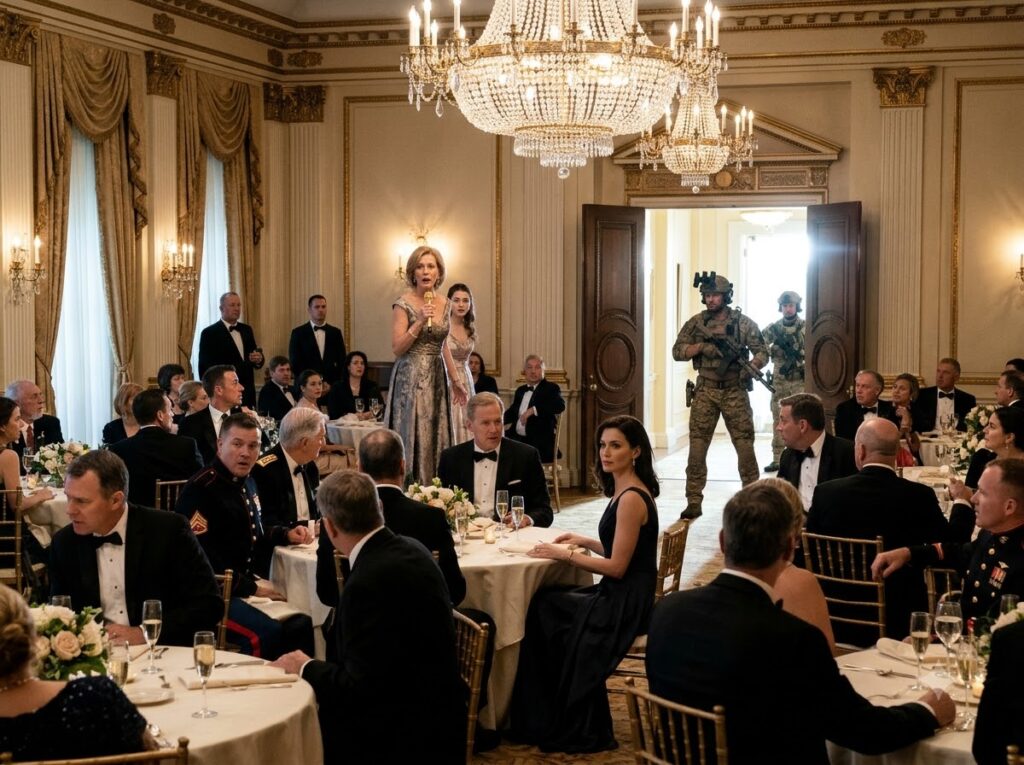
My mother, Eleanor, adjusted her grip on the gold microphone. Her voice, smooth and polished as a marble tombstone, echoed through the ballroom of the Hay-Adams once more.
“For years, I have tried to guide both of my children toward the light of our family’s legacy. A legacy built on service, on prestige, on the unyielding pursuit of excellence.” Eleanor paused, letting her gaze sweep over the crowd of admirals, senators, and defense contractors before finally landing on me, standing quietly near the back by the mahogany bar. “But one cannot force greatness upon someone who prefers the shadows of mediocrity. Evelyn has chosen her path. A life of obscure civil service, pushing papers in some forgotten basement, contributing nothing to the name my late husband fought so hard to build. And so, tonight, as we celebrate Tessa’s engagement to a man of true vision, I must formally sever the ties. Tessa is my sole heir. The only true daughter of the Hayes family.”
The silence in the room was absolute, heavy with the scent of expensive perfume and aged scotch. I could see the uncomfortable shifting of eyes. General Vance, Julian’s uncle, stared at his polished shoes. A senator from Virginia cleared his throat, taking a slow sip of his champagne. They were embarrassed for me. They saw a thirty-two-year-old woman in a simple black evening gown, publicly excised from a dynasty of power, standing completely alone.
I took a sip of my sparkling water. The lime wedge was slightly bitter. I did not cry. I did not scream. I simply checked the face of my watch.
It was 2140 hours.
“Mom, please,” Tessa said, taking the microphone, her voice dripping with weaponized empathy. “Let’s not dwell on the past. Evelyn has made her choices. We wish her well in… whatever it is she does. But tonight is about the future. About Julian, and me, and the new defense contracts his company is bringing to the Capitol.”
I looked at Julian. He was handsome in that sharp, predatory way that always played well on cable news. He offered a humble wave to the crowd, soaking in the applause that began to ripple through the ballroom. He was currently holding the highest-level security clearance awarded to a civilian contractor. He was also, according to the encrypted files resting on a secure server at Fort Meade, actively selling next-generation drone schematics to a hostile foreign intelligence network.
I set my glass down on the bar. The bartender, a young man who looked thoroughly traumatized by the family drama he had just witnessed, reached out to take it.
“I’d step back from the doors if I were you,” I told him quietly.
He blinked. “Excuse me, miss?”
At 2141 hours, the heavy, brass-studded oak doors of the Hay-Adams ballroom did not simply open. They were kinetically breached.
The sound was like a thunderclap in the enclosed space. The doors blew inward, the massive brass hinges groaning and snapping under the sheer force of the entry. The splintering of wood was immediately followed by the synchronized, heavy thud of tactical boots against the marble floor.
Screams erupted from the front of the room. Women in thousand-dollar gowns dropped their crystal flutes, the glass shattering over the polished floor. The retired officers in the room instinctively dropped low, their military training kicking in decades after their last deployment.
Through the dust and the chaos marched twelve men in full, unmarked tactical gear. They moved with a terrifying, liquid precision, a silent wave of matte-black Kevlar, suppressed assault rifles, and night-vision optics pushed up on their helmets. They did not shout. They did not issue commands. They moved with the cold, calculated efficiency of operators who had breached compounds in Kandahar and safe houses in Yemen.
“What is the meaning of this?!” Eleanor shrieked, clutching her chest, dropping the gold microphone. It hit the floor with a harsh electronic squeal.
“Security! Where is hotel security?” Julian bellowed, stepping in front of Tessa, playing the brave protector.
The operators ignored them. They fanned out, securing all four exits in a matter of seconds. Two men flanked the shattered main doors, their rifles resting in low-ready positions, their eyes scanning the room behind dark ballistic visors.
The lead operator, a mountain of a man whose tactical rig was covered in dust and strapped with enough ordinance to level a city block, strode directly down the center of the room. The crowd parted for him as if he were a ghost. He walked past the overturned tables. He walked past my mother, who was hyperventilating into the hands of a retired Navy Admiral. He walked past Julian, who had suddenly gone very, very pale.
The operator stopped directly in front of me.
The ballroom held its collective breath. My mother stared, her mouth hanging open, expecting the armed men to drag her disgraced, paper-pushing daughter out of the room.
The giant man in black reached up, unclipped his helmet, and pulled it off. Chief Petty Officer Miller’s face was smeared with dark camouflage paint, his eyes sharp and serious. He stood at attention, his posture rigid, and snapped a crisp, flawless salute.
“Commander,” Miller’s deep voice echoed in the dead silence of the ballroom. “Perimeter is secure. The building is locked down. Ghost Team is holding at the extraction point.”
I returned his salute with a sharp, fluid motion. “Status on the secondary targets, Chief?”
“Hard drives recovered from the Vance Defense servers in Virginia ten minutes ago, ma’am. We have the wire transfers. We have the offshore routing numbers. The trap is closed.”
“Excellent work, Miller.”
I stepped away from the bar. The transformation in the room was absolute. The forty-two guests, who moments ago had watched me be publicly stripped of my family name, were now staring at me with a mixture of profound shock, awe, and rising terror.
I walked slowly toward the front of the room. My heels clicked rhythmically against the marble floor. I stopped directly in front of the small stage where my mother and sister stood frozen.
Popular Posts
→- 1
- 2
- 3
- 4




Recently Viewed
Stories you read recently will appear here.





