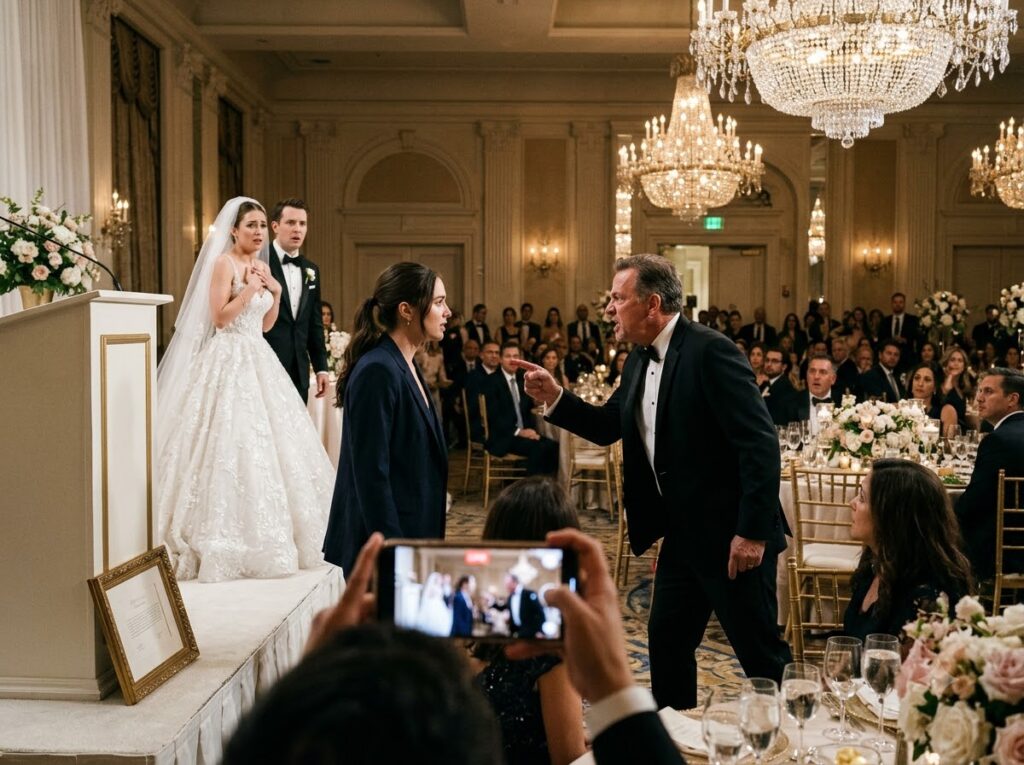
I leaned against the cool plaster near the service doors, my arms crossed over my simple, dark dress. I wasn’t a bridesmaid. Olivia had decreed that my aesthetic was too “severe” for her pastel-and-gold vision, a decision my parents had readily endorsed. I was simply the blood relative required to be present, useful for coordinating the caterers and managing the seating chart crises.
“Family, friends, esteemed colleagues,” my father began, his voice booming effortlessly through the microphone. “We are gathered tonight to celebrate perfection. And looking at my beautiful daughter, Olivia, and her new husband, David, I think we can all agree that perfection has been achieved.”
Polite laughter rippled through the crowd. Olivia beamed, resting her head on David’s shoulder. She looked like a porcelain doll wrapped in imported silk.
“Olivia has always been the light of our family,” my father continued, placing a hand over his heart. “She brings joy, beauty, and grace into every room she enters. And when a father watches his golden girl step into a new chapter of her life, he wants to ensure her foundation is as solid as the love we have for her.”
He reached into the breast pocket of his tuxedo and produced a heavy, ornate envelope sealed with gold wax. Beside it, dangling from a silk ribbon, was an antique brass key. My heart gave a strange, uneven thud. I knew that key. I had spent three weeks restoring the original 1920s mortise lock it belonged to.
“David, Olivia,” my father said, his voice thickening with manufactured emotion. “A marriage needs a home. Not just a house, but a sanctuary. For the past three years, our family has been quietly preparing a special property. A historic Victorian on Hawthorne Lane, completely gutted, rebuilt, and modernized, all while preserving its original soul. Tonight, I am handing over the deed. The house is yours. Start your family. Build your legacy.”
The crowd erupted into thunderous applause. Olivia gasped, covering her mouth with her hands as tears of joy spilled over her perfect eyelashes. David looked stunned, shaking my father’s hand vigorously.
The air in my lungs turned to ash.
Hawthorne Lane. My house.
Three years ago, I had bought that dilapidated, rotting Victorian at a foreclosure auction using every cent of my savings. My father had mocked the purchase, calling it a money pit. For thirty-six months, I had lived in a dust-filled construction zone. I had bled over the hardwood floors I sanded myself. I had spent freezing winters without heating, saving money to hire an electrician to rewire the grid. I had restored the stained glass, rebuilt the wraparound porch, and poured my absolute soul into making it a masterpiece. My father had never lifted a hammer. He had never contributed a dime. But he knew the house was finally finished. He had toured it last week, his eyes calculating the newly appraised value.
He didn’t just want to give Olivia a house. He wanted to give her my masterpiece, assuming, as he always did, that I would simply absorb the loss. I was the workhorse. Olivia was the show pony. What was mine had always been treated as theirs to redistribute.
I didn’t plan the steps I took next. I didn’t think about the two hundred and eighty influential guests, or the cameras flashing, or the social ruin that would follow. The sheer, suffocating audacity of his theft bypassed my brain and moved directly into my legs.
I pushed off the wall and walked onto the dance floor. The applause began to die down as people noticed me—a dark, unsmiling figure cutting through the sea of pastel gowns. My father saw me approaching, and his smile tightened into a rigid line of warning. His eyes, cold and flinty, sent a silent, familiar threat across the room: Stand down, Quinn. Do not ruin this.
I stopped ten feet from the head table. The silence in the ballroom became absolute, heavy, and buzzing with sudden tension. Olivia lowered the brass key, her perfect brow furrowing in irritation.
I looked directly at my father, bypassing the microphone, my voice carrying clearly through the cavernous room.
“It’s mine.”
The words hung in the air, sharp and undeniable.
My father’s face flushed a deep, dangerous crimson. He stepped away from the microphone, handing it to David, and walked swiftly down the steps of the dais toward me. He thought he could intimidate me. He thought the sheer weight of his presence would crush my rebellion, just as it had when I was a child.
“Quinn,” he hissed, his voice dropping to a low, guttural register meant only for me, though the front row of tables could hear every syllable. “You will turn around, you will walk out those doors, and you will give me the deed tomorrow, or I will ruin you. You owe this family.”
“I owe you nothing,” I said, my voice remarkably steady. I looked past him to the crowd. “He didn’t buy that house. He didn’t build it. My name is on the deed, and he is trying to give away a home he does not own to a daughter who has never worked a day in her life.”
Olivia let out a sharp, dramatic sob, burying her face in her hands.
That was the trigger. My father’s meticulously crafted public persona violently shattered. He did not see a grown woman asserting her legal rights; he saw an insubordinate piece of property ruining his grandest performance.
He lunged forward. His large, heavy hand clamped around the back of my neck. He spun me around with terrifying force, his fingers digging into my skin, and shoved me forward.
The ballroom wall, adorned with a massive, ornate gilded mirror, rushed up to meet me.
The crack echoed under the chandelier.
Popular Posts
→- 1
- 2
- 3
- 4




Recently Viewed
Stories you read recently will appear here.





