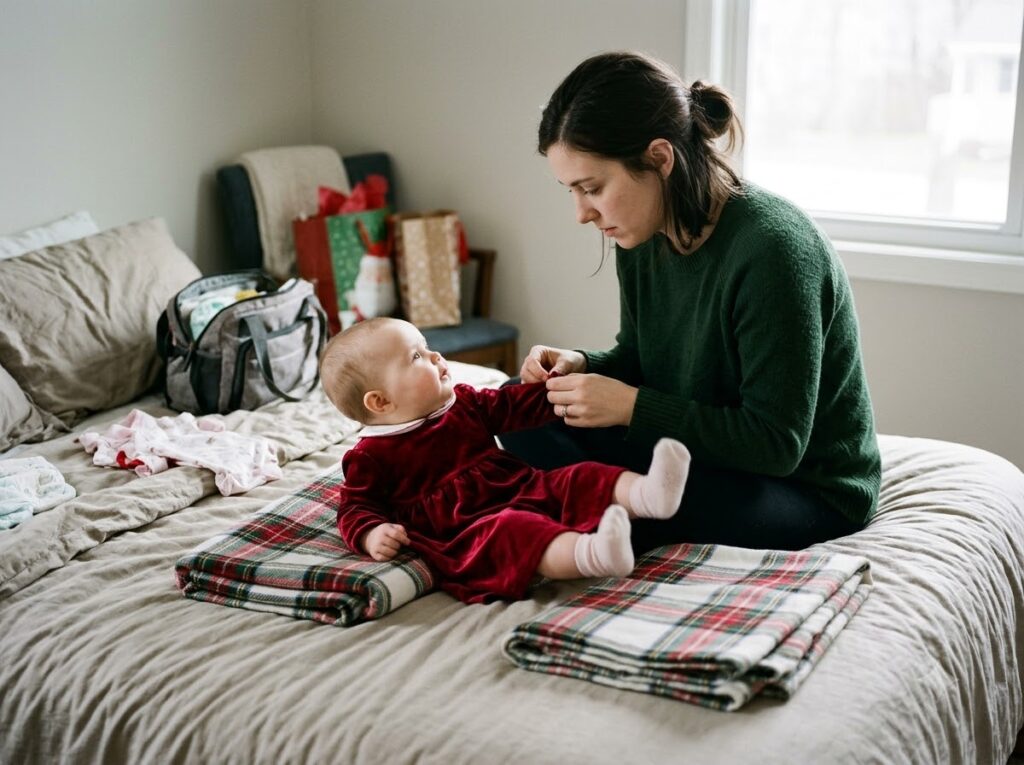
But to my mother, Eleanor, Lily’s difficult start was simply an inconvenience. Worse, it was a flaw. In my mother’s world, everything was a reflection of her own pristine image, from the immaculately landscaped front lawn to the accomplishments of her children. A premature, underweight grandchild did not fit the aesthetic of her perfect holiday newsletters.
I smoothed the velvet over Lily’s chest, trying to calm the sudden, violent tremor in my hands. You are overreacting, I told myself, echoing the exact phrase my mother had used to gaslight me for twenty-eight years. It’s just dinner.
My husband, David, stepped into the bedroom, his tie hanging loose around his collar. He looked at the two of us, his gaze softening before shifting into a look of quiet concern. He knew the toll these visits took on me. He had spent the last three Christmases playing peacekeeper, subtly steering conversations away from my mother’s barbed comments, stepping into the line of fire whenever she set her sights on my weight, my career, or my parenting.
“We don’t have to go,” David said gently, crouching down to stroke Lily’s cheek. She cooed, grabbing his finger with surprising strength. “I mean it. I can call her right now and say Lily has a fever. We can order Chinese food and watch movies in our pajamas.”
God, the temptation was a physical ache in my chest. But the ingrained, lifelong training of a daughter raised by a narcissist kicked in. If we didn’t go, the punishment would be far worse than the event itself. The passive-aggressive social media posts, the tearful voicemails to my relatives about how I was keeping her grandchild away from her, the months of icy silence followed by sudden, explosive rage.
“We’ll go,” I said, lifting Lily into my arms and burying my face in her sweet, baby-powder-scented neck. “It’s only four hours. We eat the dry turkey, we nod at her monologues, we let her take her photos for Facebook, and we leave.”
The drive to my parents’ estate in the suburbs felt like a march to the gallows. Snow had begun to fall, dusting the pine trees in a picturesque layer of white that looked exactly like the expensive greeting cards my mother mailed out by the hundreds. When David turned the car into the sweeping circular driveway, every window of the massive colonial house was blazing with golden light. There were already a half-dozen luxury cars parked out front. My brother, Paul—the golden child who could do no wrong—had arrived with his wife and their three robust, athletic, loud children.
I took a deep breath, clutching the diaper bag like a shield.
The moment we stepped into the grand foyer, the overwhelming scent of cinnamon, pine, and expensive perfume hit me. My mother was holding court by the towering, professionally decorated Christmas tree, a glass of champagne in one hand. She wore a tailored emerald pantsuit, her hair blown out to perfection, laughing at something my aunt had just said.
When she saw us, the smile didn’t quite reach her eyes, but she immediately assumed the pose of the doting matriarch for her audience.
“Oh, look who finally decided to brave the weather!” my mother announced loudly, sweeping across the marble floor. She didn’t hug me. Instead, she leaned in, kissed the air next to my cheek, and immediately directed her critical gaze to the baby in my arms.
“Well,” Eleanor sighed, her manicured nails adjusting the collar of Lily’s dress with a slight frown. “She certainly is… petite, isn’t she? I thought you said she was finally on the growth chart.”
“She is on the growth chart, Mom,” I said, keeping my voice even. “She’s doing wonderfully. Her pediatrician is very happy.”
“If you say so,” my mother murmured, loud enough for Aunt Susan to hear. “I just remember Paul’s children being so much more sturdy at this age. They were crawling everywhere. She just sort of… sits there. Are you sure you’re giving her enough tummy time? She looks a bit listless.”
My jaw tightened. Lily wasn’t listless; she was overwhelmed by the noise and the unfamiliar faces. “She’s perfectly healthy,” David interjected, stepping smoothly between my mother and the baby. “And she’s the happiest kid in the world. Merry Christmas, Eleanor.”
The first two hours were a masterclass in psychological warfare. To the untrained eye, my mother was the perfect host. But every interaction was laced with poison. When I declined a second glass of wine, she loud-whispered to my sister-in-law about how I was always so “rigid and highly strung.” When I quietly excused myself to change Lily’s diaper, she complained to the room that I was “coddling” the baby and isolating myself from the family.
I swallowed the anger. I swallowed the humiliation. I smiled until my face ached. I kept telling myself: Just make it through dinner.
The dining room was a spectacular display of crystal, silver, and imported holly. Fifteen of us sat around the sprawling mahogany table. The wine flowed, the conversation grew louder, and the room temperature began to rise. Lily, sitting in the high chair David had meticulously sanitized and set up between us, was starting to fuss. She was tired, the room was too warm, and the sheer volume of my brother’s booming laughter was jarring her nerves.
I handed her a soft teething toy, murmuring quiet comforts. “Shh, sweetie, almost done. Mommy’s right here.”
My mother, seated at the head of the table, stopped her story mid-sentence. She placed her silver fork down on her china plate with a sharp, echoing clink. The table fell silent, instinctively sensing the shift in the matriarch’s mood.
“Really, must we listen to that whiny grating sound through the entire meal?” she snapped, glaring down the length of the table directly at my eight-month-old daughter.
“She’s just tired, Mom,” I said quietly, feeling my heart rate begin to spike. “It’s past her bedtime. She’s doing her best.”
Popular Posts
→- 1
- 2
- 3
- 4




Recently Viewed
Stories you read recently will appear here.





