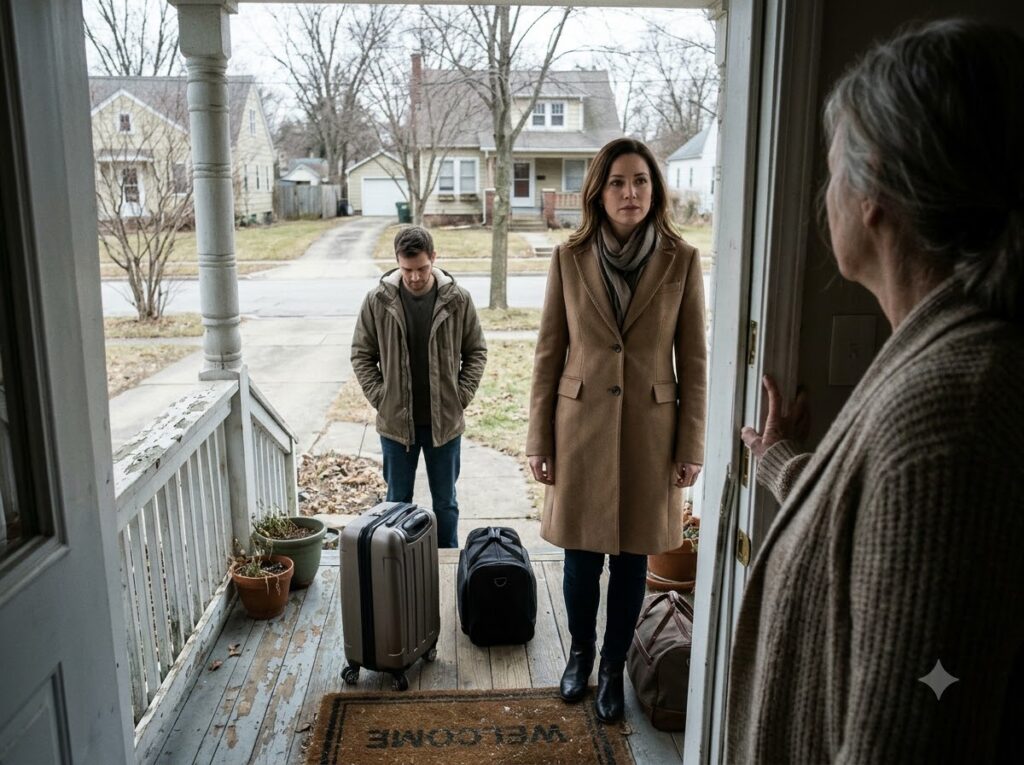
“Marcus,” I said, my voice sounding far thinner than I would have liked. It came out like dry paper sliding across a rough floor. “Bring the bags inside. Don’t leave them on the porch.”
Marcus hesitated. He was thirty-eight, but for one terrible second on the top step, he looked like the twelve-year-old boy who had come home with a shattered bicycle and a lie about how it had happened on its own. His shoulders were rounded, curved inward like a ribcage trying to protect a heart that had already stopped beating. He reached down, his fingers curling around the leather handle of the larger suitcase, but he didn’t lift it.
“Mom,” he muttered, his eyes fixed on the gray concrete between his boots. “It’s… look, we didn’t have anywhere else to go. The foreclosure notice came this morning. The sheriff was already talking about the writ of possession by noon.”
“Inside, Marcus,” I repeated. Not louder, just firmer.
Vanessa stepped past me without waiting for an invitation. Her heel clicked sharply against the oak threshold—a sound I had polished every Saturday morning for twelve years. She didn’t wipe her feet. She walked straight into the hallway, her designer bag swinging against her hip, and her gaze drifted immediately up the staircase, toward the guest room where my sewing basket still sat on the maple table.
“We’ll need to clear out the little bedroom,” she said, her voice light, almost conversational, as if we were discussing what to order for takeout after a long drive. “The light in the back room is better for the desk anyway. I can set up my remote office there by Monday.”
I closed the front door behind them. The click of the latch sounded final, like the drop of a bolt in a cell door.
I. The Anatomy of a Collapse
We sat at the round oak kitchen table—the same table I had bought second-hand thirty years ago when Marcus was starting kindergarten, sanding down the water rings and staining it walnut with my own hands.
Vanessa remained standing, leaning against the counter where my kettle sat. She refused the kitchen chair, as though sitting down would mean acknowledging she was a guest in a house she hadn’t chosen. Marcus sat opposite me, his hands locked between his knees, staring at the grain of the wood.
“Six hundred and twenty thousand dollars,” I said quietly. The number sat between us like a dead animal no one wanted to name. “How do you lose six hundred and twenty thousand dollars in eighteen months, Marcus? That wasn’t just the house on Maple Street. That was the equity from your first condo, plus the cash-out refi, plus…” I stopped. I didn’t want to say my forty thousand. It felt too small now, a drop of water thrown into a furnace.
“It wasn’t just us, Mom,” Marcus said, his voice rising a fraction, defensive the way weak men get when they’re cornered. “The market shifted. The tech sector—everyone was moving into crypto-adjacent syndicates. Julian had the contacts. He’s got three degrees from Wharton, for Christ’s sake. We weren’t just gambling; we were diversifying into high-yield liquidity pools.”
“Julian,” I repeated. “The man who drove a rented Maserati to your housewarming party and vanished to the Caymans three weeks ago?”
“He didn’t vanish, he’s restructuring—”
“He’s a con artist, Marcus. Even the local news ran a three-minute segment on him between the weather and the high school football scores.”
Vanessa let out a short, sharp breath that was half-laugh, half-scoff. She turned from the counter, her arms crossed over her designer coat. “Oh, please. Don’t talk about things you don’t understand, Clara. This isn’t about local news or small-town savings accounts. This was a macro-economic miscalculation. Anyone could have fallen for it if they had the capital to get in early.”
I looked at her. Really looked at her.
For five years, since Marcus had brought her home to Sunday pot roast, I had tried to stretch myself to fit her world. I had bitten my tongue when she turned her nose up at my gravy because it wasn’t made with shallots and white wine. I had smiled when she told me my curtains were “quaint, in a very rustic way.” I had given them forty thousand dollars because she cried at the kitchen island, talking about how important it was for their future children to have a yard with real grass instead of shared apartment landscaping.
“You’re right, Vanessa,” I said softly. “I don’t understand macro-economics. But I do understand arithmetic. I understand that twelve thousand hours of night shifts at the county hospital equals forty thousand dollars after taxes. And I understand that when you lose nearly three quarters of a million dollars on a man named Julian who wore loafers without socks, you don’t get to stand in my hallway and tell me where your desk is going.”
The kitchen went dead silent. The hum of the refrigerator seemed to double in volume, a low, rhythmic thrum against the drywall.
Vanessa’s chin went up. Her jaw tightened until a small muscle twitched beneath her skin. “Are you throwing us out? In November? With two suitcases and nowhere to go?”
“You have a car,” I said. “And you have each other. And as for nowhere to go—well, you’re here now. But let’s get one thing straight before you take off your coat.”
I stood up. At sixty-four, my knees didn’t snap the way they used to, but the stiffness in my lower back reminded me of every year I spent lifting heavy patients off gurneys while the floor supervisors argued about overtime budgets. I walked past Marcus without looking at him and stopped two feet from Vanessa. She was taller than me by three inches, especially in those heels, but I didn’t look up. I looked straight into the bridge of her nose.
Popular Posts
→- 1
- 2
- 3
- 4




Recently Viewed
Stories you read recently will appear here.





