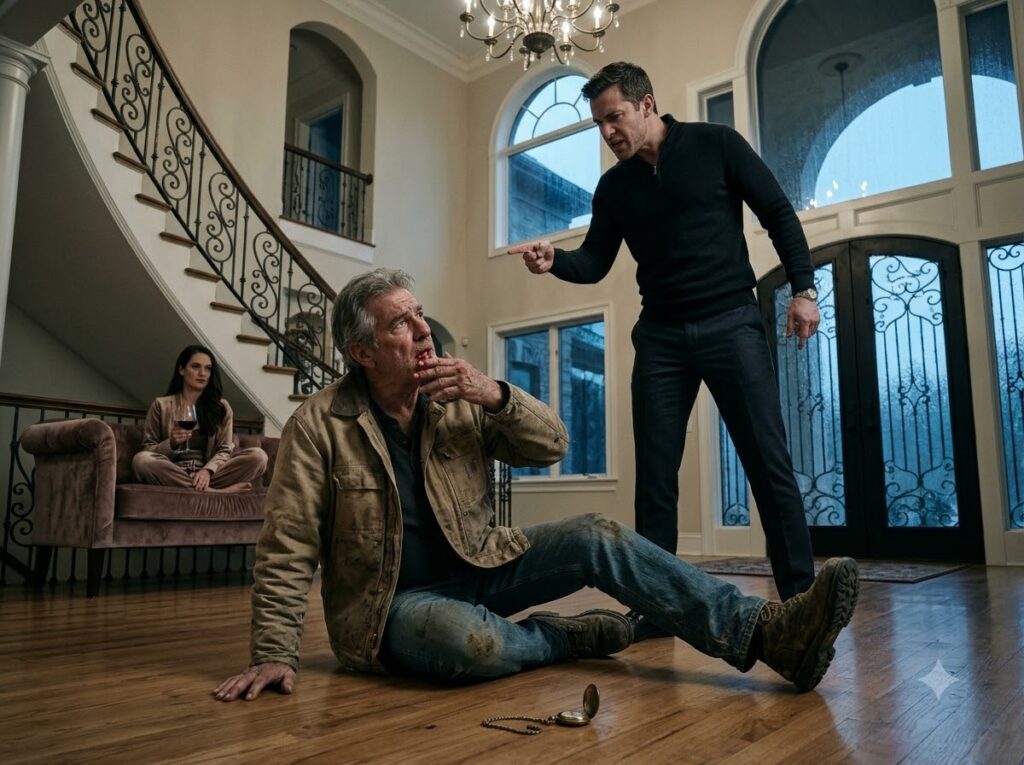
The rain beat a steady, rhythmic tattoo against the windshield as I drove toward my downtown office. My jaw throbbed where Brandon’s ring had split the skin, a dull, aching reminder of thirty years of back-breaking labor traded for a sneer and a slap. I had spent my life building highways, bridges, and commercial complexes across the state of Texas. I had hauled concrete in the dead of summer and poured foundations in freezing winters so that Brandon could go to private school, drive foreign sports cars, and pretend he was born into the aristocracy.
When he graduated with an MBA, bought into a mid-level private equity firm, and started wearing $3,000 Italian suits, I smiled from the sidelines. I let him believe his success was entirely his own. I let him call this eight-million-dollar River Oaks estate his.
I even let him believe his mother and I were simple, working-class folks who happened to get lucky on a small land sale, sparing him the reality that Vance Industrial Infrastructure—the conglomerate that had recently swallowed three regional competitors—was entirely owned by a quiet, sixty-eight-year-old man who still preferred a flannel shirt and a pair of worn-in Red Wing boots.
Until tonight. Tonight, the illusion ended.
I parked underground in the corporate garage, walked up the concrete stairwell, and unlocked the heavy mahogany doors of my top-floor office. The city lights of Houston stretched out below me through the floor-to-ceiling windows, a glittering grid of wealth and ambition that I had literally helped construct.
I turned on the desk lamp, sat down in my leather executive chair, and opened my laptop.
The first thing I did was access the corporate legal portal of Vance Infrastructure. I didn’t need to call my lawyers; I was the founder and majority shareholder, holding ninety-five percent of the voting stock.
With a few calm, precise keystrokes, I initiated Document 404-B: Revocation of Permissive Occupancy and Demand for Vacant Possession.
The River Oaks estate was not registered under Brandon’s name, nor was it held in a family trust. The deed was held under Vance Holdings LLC, a corporate entity I had established the day I bought the property. Brandon and Amber were listed merely as “permissive occupants at will”—a legal status that allowed them to live there rent-free under my corporate umbrella, revocable at any time by the managing director.
And I was the managing director.
Next, I opened a transfer portal tied to our primary commercial banking partner, First Texas National. I set up a direct wire transfer. The destination account was Brandon’s personal checking account—the one attached to his high-rolling lifestyle, his country club dues, and his newly leased Porsche Taycan.
The amount? Exactly $6,000,000.00.
To anyone else, six million dollars sounds like an unimaginable fortune. To Brandon, who had spent the last two hours boasting about his private equity acquisitions and treating me like a beggar, it was going to be the most terrifying notification of his life.
Because attached to that six-million-dollar wire transfer was a legally binding memo field, and an accompanying corporate document sent directly to his email inbox:
“Consider this your final payout, your severance from my bloodline, and the exact market value of your dignity. You wanted the house? Buy it from the LLC. You have until 9:00 AM tomorrow to wire the funds back to purchase the estate at market value, or vacate the premises. The eviction notice is attached.”
I hit Send.
The digital receipt blinked green on my screen. Done.
I leaned back in my chair, picked up my father’s antique Korean-war pocket watch from my desk, and popped the silver casing open. The second hand swept in a steady, unhurried circle.
“Let’s see how well private equity teaches you to manage cash flow when the well runs dry, son,” I whispered to the empty office.
By 8:45 AM the next morning, the Texas sun was burning off the lingering mist, casting a brilliant golden light across the manicured lawns of River Oaks.
I pulled my Ford F-150 up to the massive wrought-iron security gates of the estate. I didn’t use the remote clicker that Brandon had reprogrammed last year to lock me out. Instead, I reached out of my truck window and punched the master access code into the keypad—the code I had programmed myself on day one, which Brandon had never bothered to change because he assumed his father was too technologically illiterate to know how keypads worked.
Click.
The heavy iron gates swung inward.
I drove up the crushed limestone driveway, parking right beside Brandon’s shiny new Porsche Taycan. The house looked magnificent in the morning light—red brick facade, towering white columns, slate roof, and massive bay windows overlooking the meticulously landscaped courtyard. It was a masterpiece of southern residential architecture.
And it was about to become very, very expensive for my son.
I stepped out of my truck, wearing my usual work boots, a faded denim shirt, and a canvas jacket. I walked up the wide stone steps to the double front doors.
Before I could even raise my hand to knock, the door flew open.
Brandon stood there in silk pajama pants and an open designer robe, his hair disheveled, his eyes bloodshot and wide with absolute, unadulterated panic. His phone was clutched in his trembling hand so tightly his knuckles were white.
Behind him, sitting at the marble kitchen island in her silk robe, Amber looked up from her iPad, her face drained of all color.
“Dad,” Brandon croaked, his voice cracking violently. He didn’t look arrogant today. The swagger was gone. The billionaire-playboy aura had evaporated into thin air. “Dad… what… what is this?”
He thrust his phone toward my face. The screen displayed his First Texas National mobile banking app.
Incoming Wire Transfer: Vance Holdings LLC.Amount: $6,000,000.00.Memo: Final Payout / Purchase Price or Eviction Notice.
Popular Posts
→- 1
- 2
- 3
- 4




Recently Viewed
Stories you read recently will appear here.





